
























Texas A&M repurposes former NASA centrifuge to study human response to moon and Mars gravity
By
Andrea Leinfelder
Summary
Texas A&M University is repurposing a former NASA centrifuge to study how the human body responds to low-gravity environments like those on the moon and Mars. The research involves spinning subjects to simulate reduced gravity conditions, with graduate and undergraduate students participating as test subjects. The work aims to better understand physiological responses to partial gravity, which is critical for future long-duration space missions.
Source
 Twitter / XTexas A&M repurposes former NASA centrifuge to study human response to moon and Mars gravityhoustonchronicle.com
Key quotes
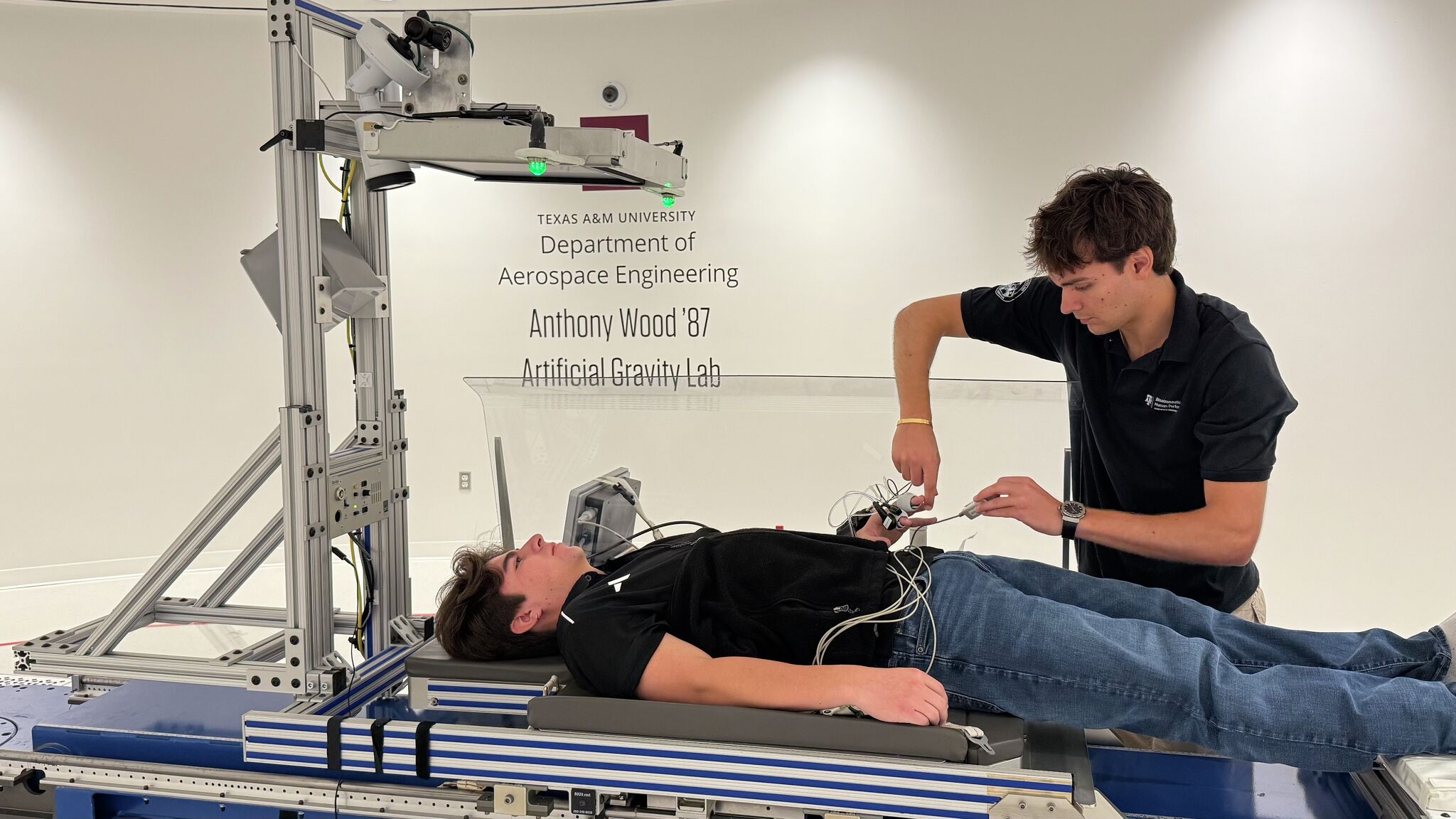
· 3 pulledSantiago Carrasco lay on his back, looking at the paused 'Looney Tunes' intro while a graduate student attached ECG electrodes to his chest and strapped a blood pressure cuff to his arm.
Huc Pentinat Llurba, right, a graduate student at Texas A&M University, prepares Santiago Carrasco, an undergraduate student, for a spin in the university's centrifuge in College Station, Thursday, June 11, 2026.
Texas A&M is using the centrifuge to learn how the human body responds to low-gravity environments like those seen on the moon or Mars.
You might also wanna read


Texas A&M study successfully regenerates skeletal and connective tissue, advancing limb regeneration research
Texas A&M researchers have made a breakthrough in tissue regeneration, successfully regenerating skeletal and connective tissue in mammals.
 stories.tamu.edu·20d ago
British Startup Mass Balance Launches Orbital Lab to Study Age-Related Proteins in Zero Gravity
British startup Mass Balance has launched a grapefruit-sized autonomous laboratory into orbit via a SpaceX transporter to study disease-caus
 wired.com·2h ago
New optical centrifuge unlocks the secrets of frictionless superfluids

Texas A&M researchers develop nasal spray that reverses brain aging in study
Researchers at Texas A&M University have developed a nasal spray that appears to reverse brain aging by reducing inflammation and restoring

Study explores link between gravitational tidal forces and human heart rhythms
Research presented at the 2026 American Physiology Summit by Dr. Guadalupe Rodríguez Ferrante explores whether human cardiovascular function
 ispyphysiology.com·29d ago
More Cartilage, Blood Pressure Studies on Station as Crew Swap Preps Begin
Comments
Sign in to join the conversation.
No comments yet. Be the first.