
























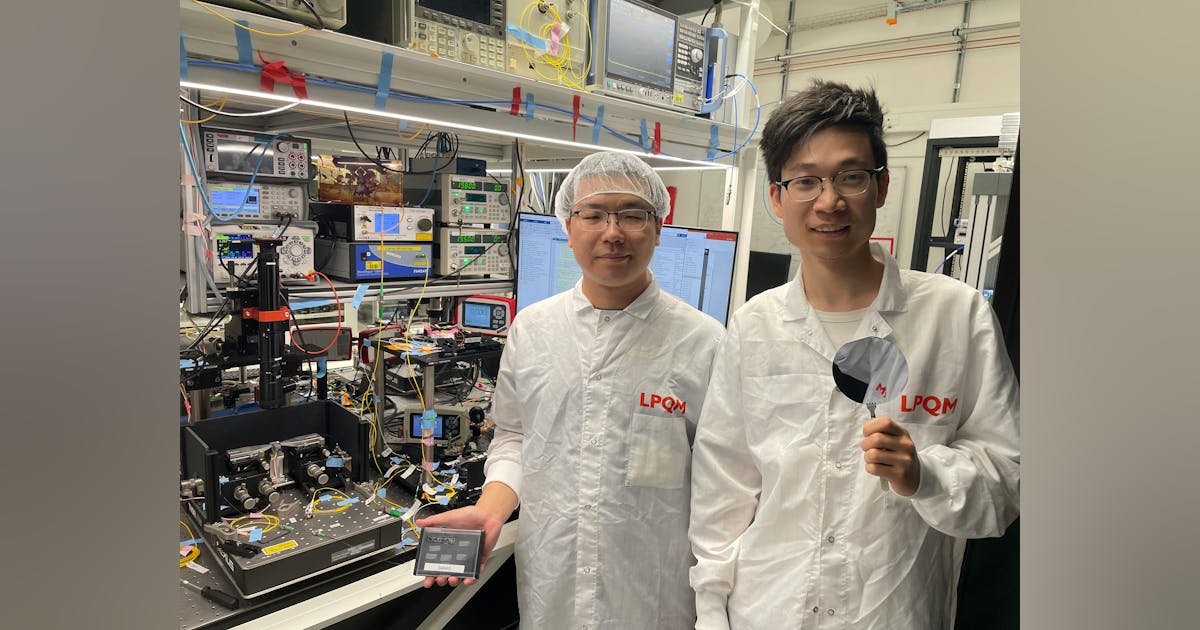
EPFL researchers demonstrate first on-chip ultrafast laser using silicon nitride photonics
By
Sally Cole Johnson
Summary
Researchers at EPFL have developed the first on-chip ultrafast laser using erbium-doped silicon nitride waveguides and Bragg gratings. The laser generates intense picosecond pulses directly on a photonic chip, enabling new capabilities for photonic integrated circuits (PICs). Using the Mamyshev oscillator concept with offset gratings, the design prevents continuous-wave lasing and only allows pulsed operation. This breakthrough brings ultrafast laser functionality to chip-scale photonics, potentially enabling more integrated applications in sensing, computing, and communications.
Source
 bskyEPFL researchers demonstrate first on-chip ultrafast laser using silicon nitride photonicslaserfocusworld.com
Key quotes
· 3 pulledUsing the Mamyshev oscillator concept, the two gratings are deliberately offset in wavelength so continuous-wave lasing can't be sustained.
No single wavelength is reflected by both gratings. Pulses, however...
Generation of intense ultrafast pulses directly on chip brings a new capability to photonic integrated circuits (PICs) and enables integration of more functionalities...
You might also wanna read


Breakthrough in Neuromorphic Photonic Computing with GHz-Scale PSNN Chip
The article discusses a groundbreaking advancement in neuromorphic photonic computing with the development of a photonic spiking neural netw
 arxiv.org·11mo ago
NIST Scientists Develop Integrated Photonic Circuits for Tunable Wavelength Lasers
NIST scientists and collaborators have developed a breakthrough method for creating integrated photonic circuits that can generate laser lig
 nist.gov·2mo ago
MEMS Photonics Chip Enables Control of Millions of Quantum Qubits with Laser Steering
Researchers from MITRE, MIT, University of Colorado Boulder, and Sandia National Laboratories have developed a MEMS (micro-electro-mechanica
 spectrum.ieee.org·2mo ago
Monolithic Magneto-Optical Isolator Achieved with Nanocomposite Garnet in Silicon Photonics
This article presents a research breakthrough in silicon photonics: a monolithically integrated magneto-optical (MO) isolator using a nanoco
 go.acs.org·6d ago
All-Optical Chip Enables Large-Scale AI Semantic Vision Generation
Researchers have developed an all-optical synthesis chip that addresses the computing power shortage in large-scale generative AI models. Th
 science.org·6mo ago
Researchers Develop Materials for Light-Based Computer Chips to Improve Efficiency and Speed
Researchers are developing light-based computers that use photons instead of electricity, which could offer greater energy efficiency and fa
Comments
Sign in to join the conversation.
No comments yet. Be the first.