
























MindReader: Open-source tool simulates brain responses to content using Meta's TRIBE v2 fMRI model
By
Jas
Summary
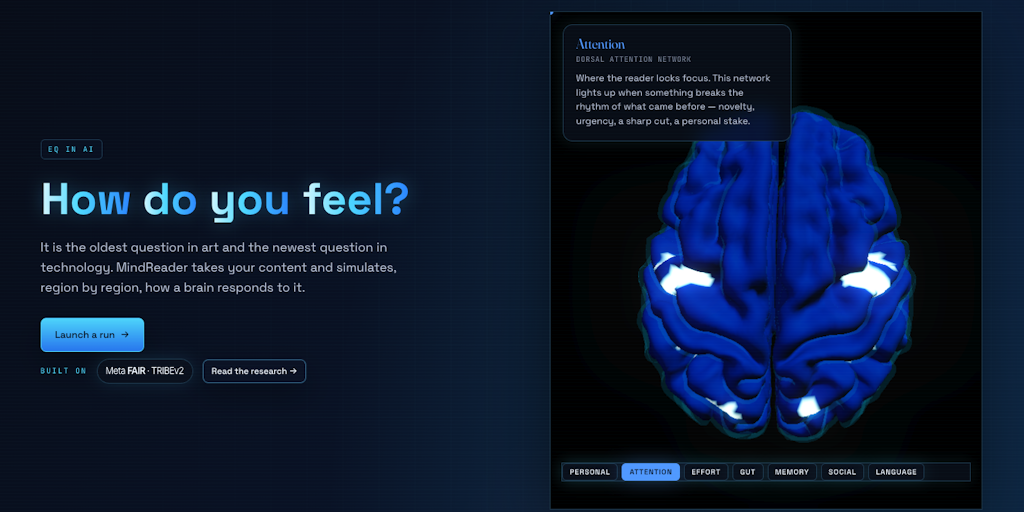
MindReader is an open-source tool that uses Meta FAIR's TRIBE v2 model (trained on ~1,000 hours of real fMRI scans across 720 subjects) to simulate how a brain responds to content. It predicts fMRI responses region by region, offering 7 neuro-metric signals as an interpretive layer. The tool is designed for content analysis, sales evaluations, and neural dataset experiments, though the creator acknowledges it predicts relative brain activity patterns rather than providing absolute measurements.
Source
 Product HuntMindReader: Open-source tool simulates brain responses to content using Meta's TRIBE v2 fMRI modelproducthunt.com
Key quotes
· 5 pulledTRIBEv2 doesn't read a brain. It predicts the fMRI response an average brain would produce, trained on ~1,000 hrs of real scans across 720 subjects.
Meta reports 2–3x better accuracy than prior encoding models, and zero-shot correlation around 0.4 on subjects it's never seen. So: good, not gospel.
What that means in practice one should trust it for relative signal (where attention holds vs. drops inside one piece of content) far more than absolute numbers.
How do you feel? It is the oldest question in art and the newest one we can answer in technology.
MindReader takes your content and simulates, region by region, how a brain responds to it. Completely Open Source - we encourage you to tinker.
You might also wanna read

Guide to Neuroimaging Datasets for Visual Perception Reconstruction from fMRI Data
This repository provides an index and overview of open neuroimaging datasets specifically for reconstructing visual perception from human fM
 github.com·3mo ago
Mind captioning: Evolving descriptive text of mental content of brain activity

Research Team Collects 10,000 Hours of Neuro-Language Data for Thought-to-Text Models
A research team has collected approximately 10,000 hours of neuro-language data from thousands of individuals over six months, claiming it t
 condu.it·6mo ago
Brain-IT: Transformer-Based Image Reconstruction from fMRI Brain Recordings
Brain-IT is a novel AI method that reconstructs images from fMRI brain recordings using a Brain-Interaction Transformer. The system achieves
 amitzalcher.github.io·7mo ago
Meta releases non-invasive brain-computer interface that reads thoughts through magnetic fields
Meta has released version two of its Brain2Qwerty brain-computer interface, which uses a non-invasive magnetoencephalography (MEG) scanner t
 tomshardware.com·4h ago
How AI models are being repurposed as tools to study the human brain
The article discusses how pretrained AI models, originally designed as engineering tools for practical tasks like predicting text, are incre
 thetransmitter.org·8d ago
Comments
Sign in to join the conversation.
No comments yet. Be the first.