
























Maximum a Posteriori Direction-of-Arrival Estimation via Mixed-Integer Semidefinite Programming
1mo ago
From the article
We propose a joint sparse maximum a posteriori (MAP) estimator for DOA estimation from multiple snapshots, reformulated as a mixed-integer semidefinite program (MISDP). This enables efficient computation of globally optimal solutions using off-the-shelf MISDP solvers based on the branch-and-bound method. Unlike other nonconvex approaches for joint sparse recovery, such as the greedy methods and sparse Bayesian learning techniques, it provides a solution with an optimality assessment even with early termination. Additionally, we present a more scalable approximate solution approach for the MISDP problem based on randomized rounding. Numerical simulations demonstrate the improved threshold behavior, resolution, and robustness of our proposed method against popular DOA estimation methods. In particular, the proposed method applied with the randomized rounding algorithm exhibits a superior estimation performance at a significantly reduced running time, compared to the deterministic maximum likelihood (DML) estimator.
Continue reading on IEEEYou might also wanna read


Geometric and Stochastic Analysis of Discontinuities in Sparse Mixture-of-Experts Architectures
This paper provides a rigorous geometric and stochastic analysis of discontinuities in Sparse Mixture-of-Experts (SMoE) architectures, which
 arxiv.org·19d ago
Adaptive Polyak Step Sizes for Sharpness-Aware Minimization: Theory-Grounded Learning Rate Schedulers
This paper introduces adaptive learning rate schedulers for Sharpness-Aware Minimization (SAM), a popular optimizer for training machine lea
arxiv.org·8h ago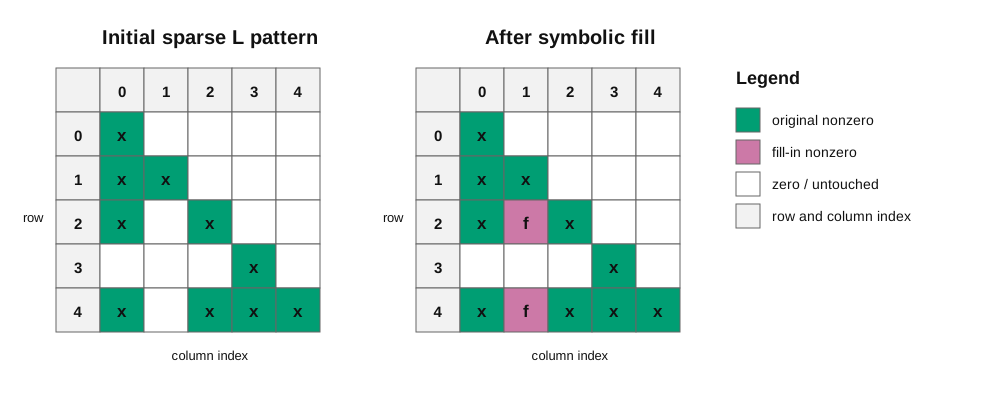
Deriving the Sparse Cholesky Elimination Tree for Matrix Factorization
This article provides a technical derivation of the elimination tree for the right-looking sparse Cholesky algorithm (A = LL^T) for sparse m
Math, Numerics, and Software·2mo ago

FP8 Tensor Cores Enable FP64-Equivalent 3-D FFT on NVIDIA Blackwell Ultra via Ozaki-Bailey Decomposition
This technical paper presents the Ozaki-Bailey FFT, a method for achieving full FP64-equivalent 3-D FFT performance on NVIDIA's Blackwell Ul
arxiv.org·5d ago
Comments
Sign in to join the conversation.
No comments yet. Be the first.