





















Study links rhizosphere bacteria and metabolites to desert ephemeral plant survival strategies

A second-rack bagel that's nearly first-rack. Tasty stuff.
Summary
This article summarizes a Functional Ecology research study on desert ephemeral plants in China's Gurbantünggüt Desert. It explores how these plants survive in extremely water-scarce conditions with a short growing season by rapidly completing their life cycle after snowmelt. The research links rhizosphere bacterial succession to metabolite dynamics to understand the underlying survival strategies of these plants, specifically how they efficiently coordinate root growth and reproduction under limited resources.
Key quotes
· 3 pulledIn China's Gurbantünggüt Desert, water is extremely scarce and the growing season is very short.
In this harsh environment, ephemeral plants have evolved a unique survival way: they can quickly complete their entire life cycle from germination to seed production within a few weeks after snowmelt.
However, under such limited resources, how these small plants efficiently coordinate root growth and reproduction remains a key question.
You might also wanna read

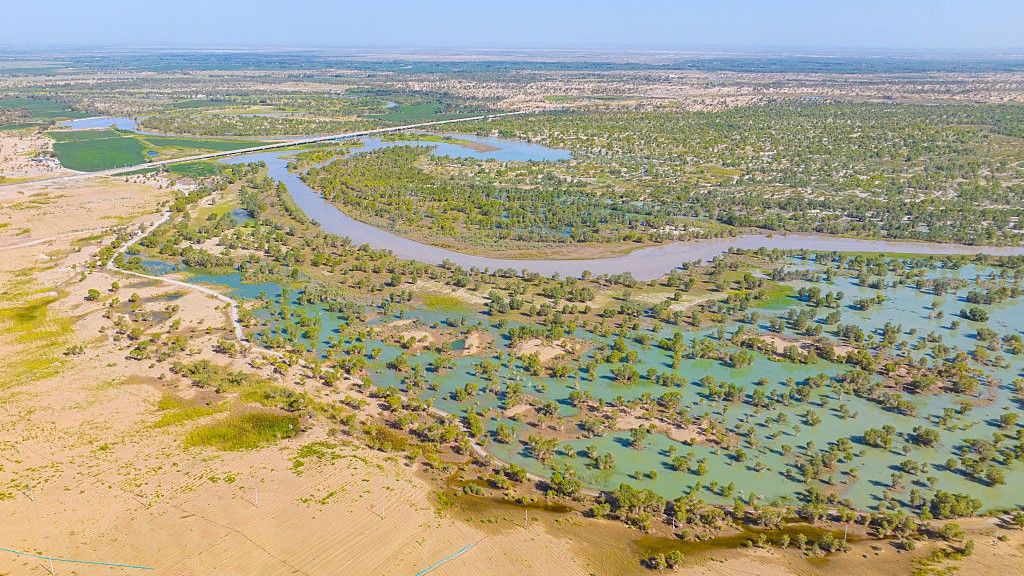
China's Tree Planting Transforms Taklamakan Desert into Carbon Sink
New research reveals that China's massive tree-planting efforts around the Taklamakan Desert have transformed the region from a 'biological
 livescience.com·3mo ago
Arctic Research Expedition Studies Underground Fungal Networks and Carbon Storage
A team of biologists led by Michael Van Nuland embarks on an Arctic road trip along Alaska's Dalton Highway to study the critical undergroun
 quantamagazine.org·1mo ago
Microbe Chroococcidiopsis Shows Potential to Produce Oxygen from Martian Soil
Scientists have discovered that the extremophile microbe Chroococcidiopsis can grow on materials similar to Martian soil and produce oxygen,
 scienceclock.com·6mo ago
Understanding Why Cool-Climate Plants Fail in Hot Regions: The Critical Role of Nighttime Temperatures
The article explores why cool-climate plants cannot thrive in hot climates, specifically focusing on the author's experience moving from the
 crimepaysbutbotanydoesnt.com·9mo ago
He Jiankui PhD Thesis: Spontaneous Emergence of Hierarchy in Biological Systems

Geothermal Amoeba Sets New Upper Temperature Limit for Eukaryotes at 63°C
Researchers have discovered a novel geothermal amoeba, Incendiamoeba cascadensis, that divides at 63°C (145.4°F), establishing a new record
 biorxiv.org·5mo ago