
























Study Shows Encrypted Smartphone Traffic Can Reveal Behavioral States Like Stress and Loneliness
By
[Submitted on 2 May 2026 (v1), last revised 5 Jun 2026 (this version, v2)]
Summary
This research paper investigates whether encrypted smartphone network traffic can serve as a passive sensing signal for behavioral states such as sleep disturbance, stress, and loneliness. Using a transformer-based model with user-specific adapters, the researchers learned representations of network activity while accounting for personal baselines. They found that stress is predominantly associated with persistent between-person variation, loneliness is more strongly linked to within-person fluctuations, and sleep disturbance reflects a combination of both. The study demonstrates that encrypted network traffic contains interpretable behavioral information that can support passive, scalable monitoring of behavioral dynamics, particularly changes relative to an individual's typical activity patterns.
Source

 bskyStudy Shows Encrypted Smartphone Traffic Can Reveal Behavioral States Like Stress and Lonelinessarxiv.org
Key quotes
· 4 pulledOur analysis reveals that the three outcomes are characterized by different temporal dynamics: stress is predominantly associated with persistent between-person variation, loneliness is more strongly linked to within-person fluctuations, and sleep disturbance reflects a combination of both.
These within-person behavioral signals are not recovered by conventional handcrafted network-traffic features, highlighting the advantages of learned representations for longitudinal behavioral modeling.
Our findings demonstrate that encrypted network traffic contains interpretable behavioral information and can support passive, scalable monitoring of behavioral dynamics, particularly changes relative to an individual's typical pattern of activity.
To capture both population-level patterns and individual-specific behavior, we employ a transformer-based model with user-specific adapters that learns representations of network activity while accounting for personal baselines and deviations from them.
You might also wanna read

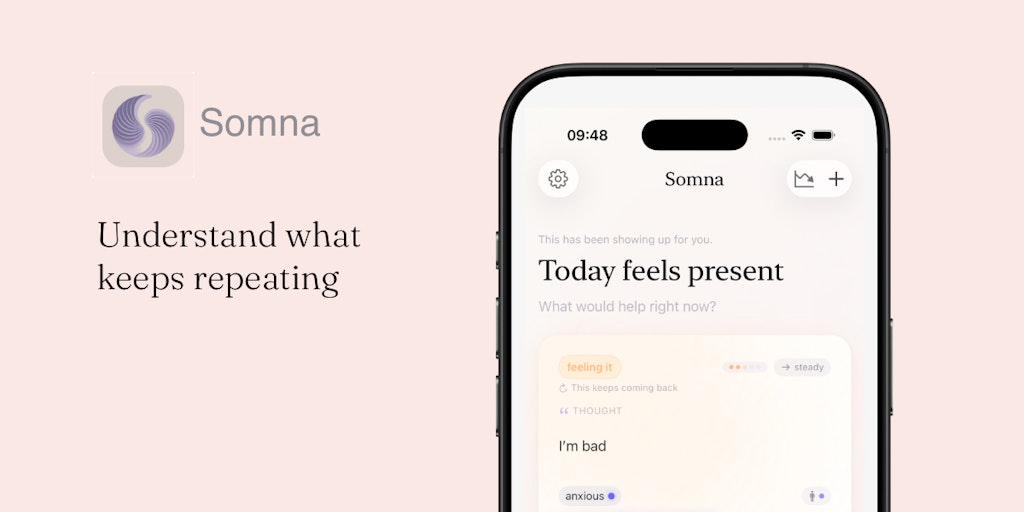
Somna: A Privacy-Focused Stress Management App That Helps Identify Stress Patterns
Somna is a stress management app that differentiates itself from typical breathing-focused apps by helping users understand the root causes
 Product Hunt·4mo ago
Experimenting with Single-Purpose Devices to Reduce Smartphone Dependence
The author reflects on nostalgia for pre-smartphone internet usage and experiments with replacing their smartphone with single-purpose devic
 ambertherambler.bearblog.dev·4mo ago
The Dopamine-Driven Design of Social Media Apps and Their Addictive Impact
The article explores how social media apps are designed to exploit dopamine-driven feedback loops, leading to addictive behaviors similar to
 lookatmyprofile.org·10mo ago
Smart Sleep Mask Security Flaw Exposes Users' Brainwave Data on Open Server
A security researcher discovered that a smart sleep mask purchased from Kickstarter was broadcasting users' brainwave data to an open MQTT b
 aimilios.bearblog.dev·4mo ago
Analysis of Apple's Unencrypted Server Connections and Surveillance Concerns
The article presents a conspiracy theory that Apple intentionally preserves unencrypted server connections in its operating systems to enabl

Foundation Models for Wearable Behavioral Data Improve Health Predictions
Researchers developed foundation models for behavioral data from wearable devices using over 2.5 billion hours of data from 162,000 individu
arxiv.org·10mo agoComments
Sign in to join the conversation.
No comments yet. Be the first.