
























Investigating C++ Memory Allocation: The 72KB Emergency Pool for Exception Handling
Why is my first C++ (m)allocation always 72 KB?? It’s the ’emergency pool’ for exceptions, here’s how I uncovered it using GDB and digging through the source code of libstdc++, glibc and Valgrind!
Read the full articleYou might also wanna read
Finding memory leaks with Memtrace
Memory issues can be hard to track down. A function that only allocates a few small objects can cause a space leak if it’s called often enou

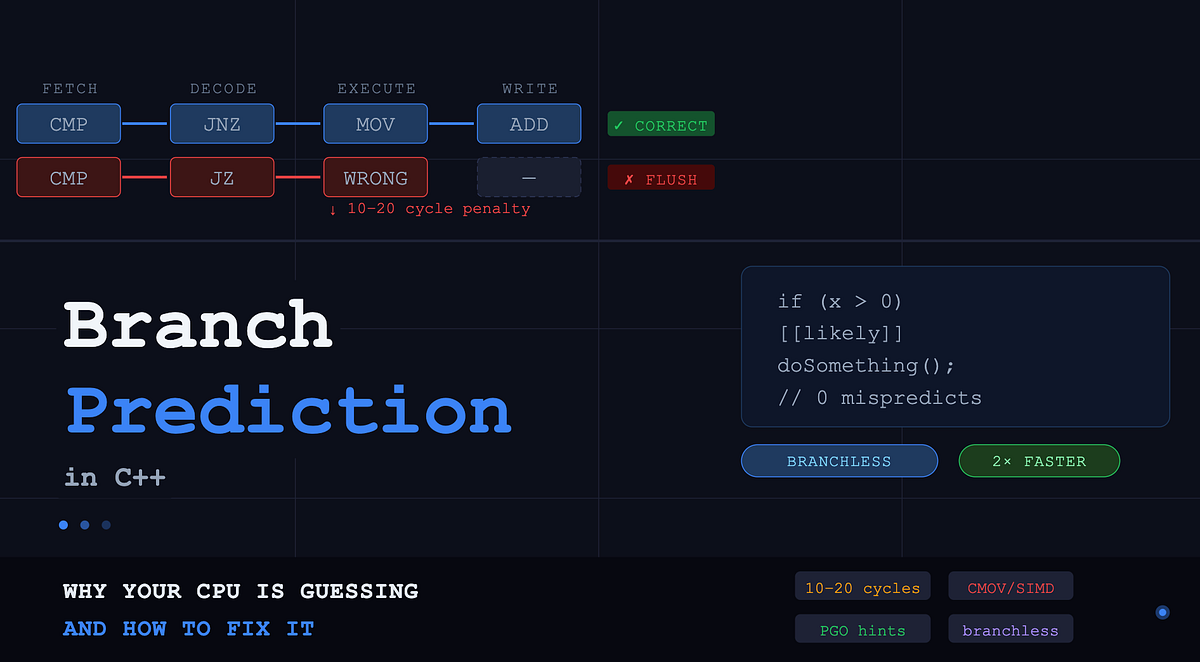
Understanding CPU Branch Prediction and Branchless Programming in C++
Stop letting CPU mispredictions slow down your code. This guide covers C++ branch prediction internals, branchless programming patterns, and
 towardsdev.com·24d ago
Why Constraints Make Better Engineers: The Case for Resource-Conscious Coding
A software engineering opinion piece argues that modern developers risk losing problem-solving sharpness due to near-unlimited access to RAM
What Happens When a Destructor Throws -- Sandor Dargo
Even experienced C++ developers sometimes stumble on a deceptively simple question: what actually happens when a destructor throws an except
OSV-2022-675: Heap-buffer-overflow in void RDKit::ParseV3000AtomProps<std::__1::vector<std::__1::basic_string_view<cha
A heap-buffer-overflow vulnerability was identified in the RDKit library during parsing of V3000 atom properties. The issue was reported by

C++ vs Python: Performance Benchmark Comparison
benchmarks,benchmark,performance,fannkuch-redux,helloworld,nbody,nsieve,spectral-norm,C++,C++ lang,Python,Python lang
programming-language-benchmarks.vercel.app·10d ago
Comments
Sign in to join the conversation.
No comments yet. Be the first.