
























AI-Powered Imaging Reveals Obesity-Related Nerve Damage, Raises Questions About GLP-1 Drug Effects
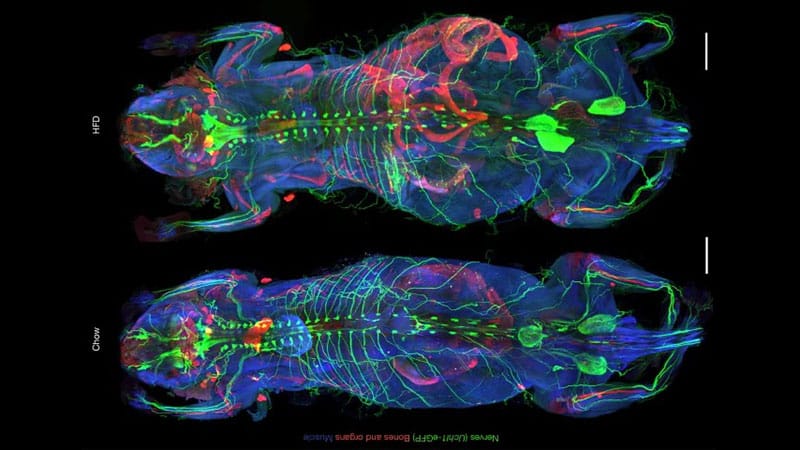
A new study published in Nature by researchers at Helmholtz Munich used an AI imaging system to detect obesity-related nerve damage (neuropathy) in both mice and humans. The research reveals previously unseen structural changes in peripheral nerves associated with obesity. The article highlights a critical unanswered question about GLP-1 receptor agonists (like Ozempic/Wegovy): whether these widely prescribed obesity drugs protect peripheral nerves or cause further damage. Small studies show conflicting evidence — some suggest GLP-1 drugs may improve nerve structure in diabetic neuropathy, while others document neuropathy cases linked to rapid weight loss from these medications. The AI-powered imaging technique offers a new way to visualize and study these nerve changes.
Key quotes
What no one can yet answer is whether those drugs are protecting their peripheral nerves or damaging them further.
Small clinical studies suggest GLP-1 receptor agonists may improve nerve structure in patients with diabetic neuropathy, yet other studies document cases where patients develop peripheral neuropathy because of rapid weight loss due to GLP-1 drugs.
A team at Helmholtz Munich in Oberschleißheim, Germany, used an AI system
From the article
You might also wanna read

AI Imaging Reveals Obesity-Related Nerve Damage; Questions Raised About GLP-1 Drug Effects on Peripheral Nerves
A new Nature study from Helmholtz Munich uses AI imaging to detect obesity-related peripheral neuropathy in mice and humans. The research re
 medscape.com·19h ago
AI Analysis of Reddit Posts Identifies Potential Side Effects of GLP-1 Weight Loss Drugs
Researchers at the University of Pennsylvania used AI to analyze over 410,000 Reddit posts spanning six years to identify potential side eff
 sciencealert.com·1mo ago
Wegovy's Canadian Launch and AI's Role in Accelerating Weight Drug Discovery
The article discusses the shifting metabolic health landscape, highlighting obesity as a complex disease and the launch of Wegovy in Canada
 startuphub.ai·8d ago
GLP-1 Receptor Agonists and Alzheimer's Disease: A Multi-National Target Trial Emulation

Health tech companies rush to market 'GLP-1 ready' products as weight loss drug trend grows
This article from Verge's Optimizer newsletter examines how health tech companies are marketing products specifically to GLP-1 drug users (p
 theverge.com·1mo ago
Obesity care's next generation will combine GLP-1 drugs with personalized therapies and advanced procedures
The article discusses how GLP-1 drugs like Ozempic, Wegovy, and Zepbound have transformed obesity treatment, but experts predict the future
Comments
Sign in to join the conversation.
No comments yet. Be the first.