
























Global Carbon Budget 2025: Anthropogenic CO2 Emissions Reach 11.6 GtC/yr with Atmospheric CO2 at 422.8 ppm
Summary
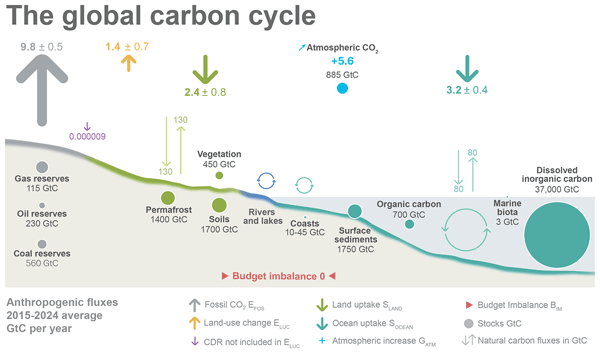
This article presents the Global Carbon Budget 2025, a comprehensive scientific assessment of anthropogenic CO2 emissions and their redistribution among the atmosphere, ocean, and terrestrial biosphere. It quantifies five major components: fossil CO2 emissions (EFOS), land-use change emissions (ELUC), atmospheric CO2 growth rate (GATM), ocean CO2 uptake (SOCEAN), and land CO2 uptake (SLAND). Key findings for 2024 include: fossil emissions at 10.3 GtC/yr (up 1.1% from 2023), total anthropogenic emissions of 11.6 GtC/yr, atmospheric CO2 reaching 422.8 ppm, and a large negative budget imbalance of -1.7 GtC/yr suggesting overestimation of sinks. Preliminary 2025 data projects further increases with CO2 reaching 425.6 ppm (53% above pre-industrial levels). The study highlights persistent uncertainties in land-use change emissions, discrepancies in northern extra-tropic land CO2 flux estimates, and differing ocean sink estimates across methods.
Source
 bskyGlobal Carbon Budget 2025: Anthropogenic CO2 Emissions Reach 11.6 GtC/yr with Atmospheric CO2 at 422.8 ppmdoi.org
Key quotes
· 5 pulledFossil CO2 emissions (EFOS) increased by 1.1% relative to 2023, with fossil emissions at 10.3 ± 0.5 GtC yr−1
The global atmospheric CO2 concentration averaged over 2024 reached 422.8 ± 0.1 ppm
Preliminary data for 2025 suggest an increase in EFOS relative to 2024 of +1.0% (0.2% to 1.7%) globally, and atmospheric CO2 concentration increasing by 2.1 ppm reaching 425.6 ppm, 53% above the pre-industrial level
The sum of all sources and sinks results in the carbon budget imbalance (BIM), a measure of imperfect data and incomplete understanding of the contemporary carbon cycle
Comparison of estimates from multiple approaches and observations shows: (1) a persistent large uncertainty in the estimate of land-use change emissions, (2) a low agreement between the different methods on the magnitude of the land CO2 flux in the northern extra-tropics, and (3) a discrepancy between the different methods on the mean ocean sink
You might also wanna read


Global CO2 Emissions Reach Record High in 2024 While EU Leads in Emission Reductions
Global CO2 emissions reached a record high of 53.2 gigatonnes in 2024, representing a 1.3% increase from the previous year. However, the Eur
 joint-research-centre.ec.europa.eu·9mo ago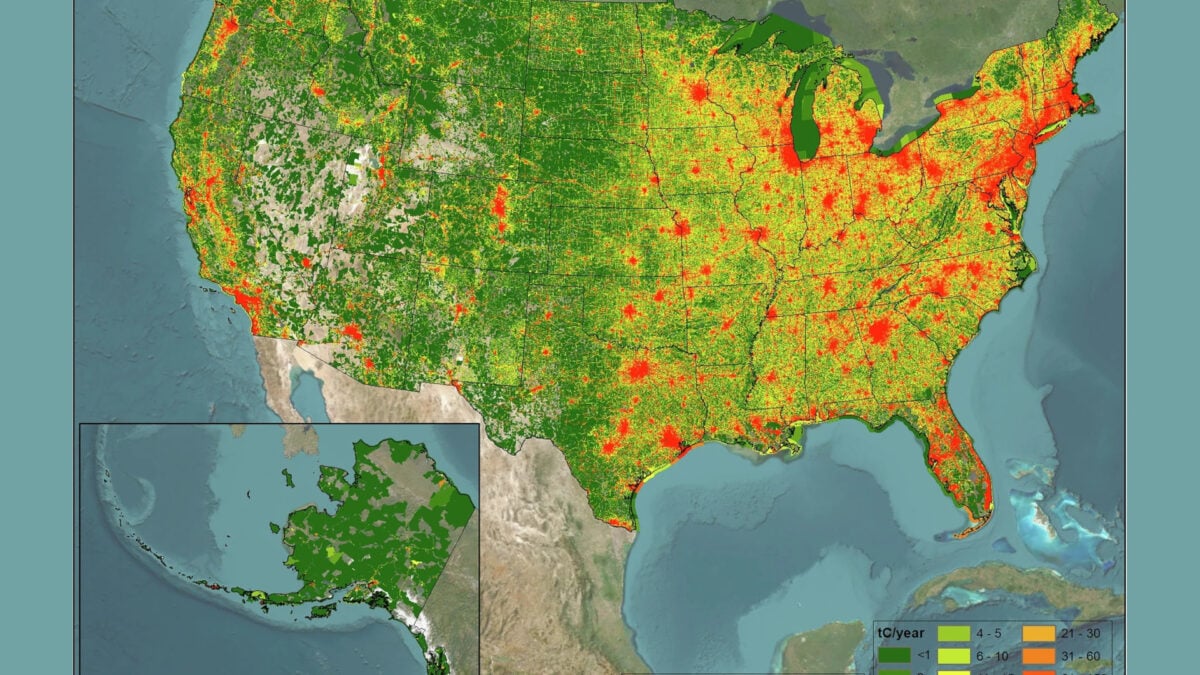
New High-Resolution Dataset Maps U.S. Carbon Emissions at Unprecedented Detail
Researchers have released the fourth version of Vulcan, a comprehensive dataset that maps CO2 emissions from fossil fuel combustion across t
 gizmodo.com·6mo ago
U.S. Carbon Emissions Rise 4.2% While China's Fall 2.7% in First Half of 2024
The United States' carbon emissions increased by 4.2% while China's emissions decreased by 2.7% in the first half of this year compared to t

Study Predicts Construction Industry Carbon Emissions Will Double by 2050
A scientific study published in Nature journal predicts that the global construction industry's carbon footprint will double by 2050 based o
 Dezeen·7mo ago
Scientific consensus confirms human activity as the primary driver of global warming
The article presents the overwhelming scientific consensus on human-caused climate change, detailing that global warming since the Industria
 en.wikipedia.org·9d ago
UNEP outlines nature-based solutions for climate and biodiversity goals
This article outlines the UN Environment Programme's (UNEP) approach to nature-based solutions for addressing climate change, biodiversity l
 unep.org·22h ago
Comments
Sign in to join the conversation.
No comments yet. Be the first.