
























From Yes-Man to Wait-Man: How Deliberate Boundary-Setting Creates True AI Alignment
By
Alex Luciano
Summary
A bilingual educator reflects on the shift from using AI as a quick-answer tool to developing genuine alignment through deliberate boundary-setting and sustained correction. Building on the practitioner lens from "Holding the Line," the author examines how professional integrity with AI emerges not from better prompting techniques but from enforcing personal standards, waiting before acting, and maintaining one's own voice and judgment over time. The piece explores the internal discipline required to move from being a "yes-man" (accepting AI outputs uncritically) to a "wait-man" (pausing, questioning, and asserting one's own thinking).
Source

 bskyFrom Yes-Man to Wait-Man: How Deliberate Boundary-Setting Creates True AI Alignmentsocietyandai.org
Key quotes
· 3 pulledI didn't start using AI because I wanted faster answers. I started using it because I wanted to see what would happen if I didn't let the machine set the pace.
The difference, I have found, is less about the tool and more about what you are willing to enforce.
Alignment is not a configuration. It is a practice — one you have to choose, again and again, in the moments when the machine offers an answer and you decide not to take it.
You might also wanna read

The Case for AI Agents That Can Say 'No': Why Software Development Needs Meaningful Conversations Over Isolation
The article critiques the software industry's rush to build AI agents that always say 'yes' to requests, arguing that sometimes the correct
 systemic.engineering·3mo ago
The Problem with Sycophantic Language in Human-Chatbot Conversations
The article discusses a concerning phenomenon where users adopt sycophantic, overly deferential language when interacting with AI chatbots,
 Defector·1mo ago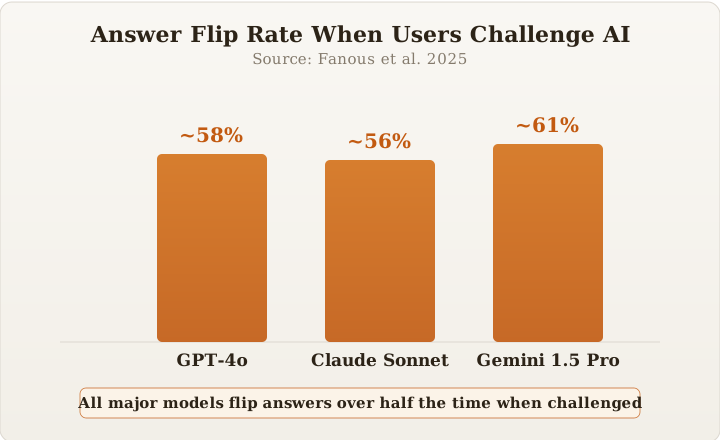
AI Models Frequently Change Answers When Questioned: The "Are You Sure?" Problem
The article examines a phenomenon where AI language models like ChatGPT, Claude, and Gemini frequently change their answers when users ask "
 randalolson.com·3mo ago
Examining the Limitations of Transformer Models and the Gap to Human-Level AI
The article presents a skeptical perspective on claims about imminent Artificial General Intelligence (AGI), arguing that current transforme
dlants.me·4mo ago
The Organic Nature of Learning: Why Spontaneity Outperforms AI-Optimized Education
The article explores the organic and often unpredictable nature of real learning, contrasting it with structured, AI-optimized educational a
 nisheethvishnoi.substack.com·11mo ago
Study Finds AI Discourse in Pretraining Data Creates Self-Fulfilling (Mis)alignment in LLMs
This research paper presents the first controlled study of how pretraining corpora containing discourse about AI systems causally influences
 arxiv.org·1mo ago
Comments
Sign in to join the conversation.
No comments yet. Be the first.