
























Inside the Space Shuttle's I/O Processor: A Technical Examination of Vintage Avionics Circuit Boards
This article examines the circuit boards from the Space Shuttle's I/O Processor (IOP), detailing the architecture and design of the Shuttle's five general-purpose computers. Each computer consisted of two 60-pound aluminum-alloy boxes, with a 32-bit CPU executing 420,000 instructions per second. These computers were built before microprocessors became popular, using multiple boards packed with simple chips and magnetic core memory instead of DRAM. The article provides a deep technical analysis of the hardware that played a critical role in controlling engines, monitoring sensors, displaying data, and navigating the Space Shuttle during each flight.
Key quotes
The Space Shuttle's five general-purpose computers played a critical role in each flight: controlling the engines, monitoring thousands of sensors, displaying data to the astronauts, and navigating the Shuttle.
Each computer consisted of two 60-pound aluminum-alloy boxes: the box on the right is the CPU, a 32-bit processor that executed 420,000 instructions per second.
These computers were designed before microprocessors became popular, so the processor was built from multiple boards crammed with simple chips and they used magnetic core memory rather than DRAM chips.
You might also wanna read


Examining circuit boards from the Space Shuttle’s I/O Processor

How NASA built Artemis II's fault-tolerant computer system with eight redundant CPUs
NASA's Artemis II spacecraft uses a highly redundant fault-tolerant computer system with eight CPUs running flight software in parallel. The
 A Learning a Day·2mo ago
NASA's Artemis II Computer System: Fault-Tolerant Design Compared to Apollo Era Technology
The article compares the computer systems of NASA's Artemis II lunar mission with the Apollo-era guidance computers, highlighting the dramat
 cacm.acm.org·3mo ago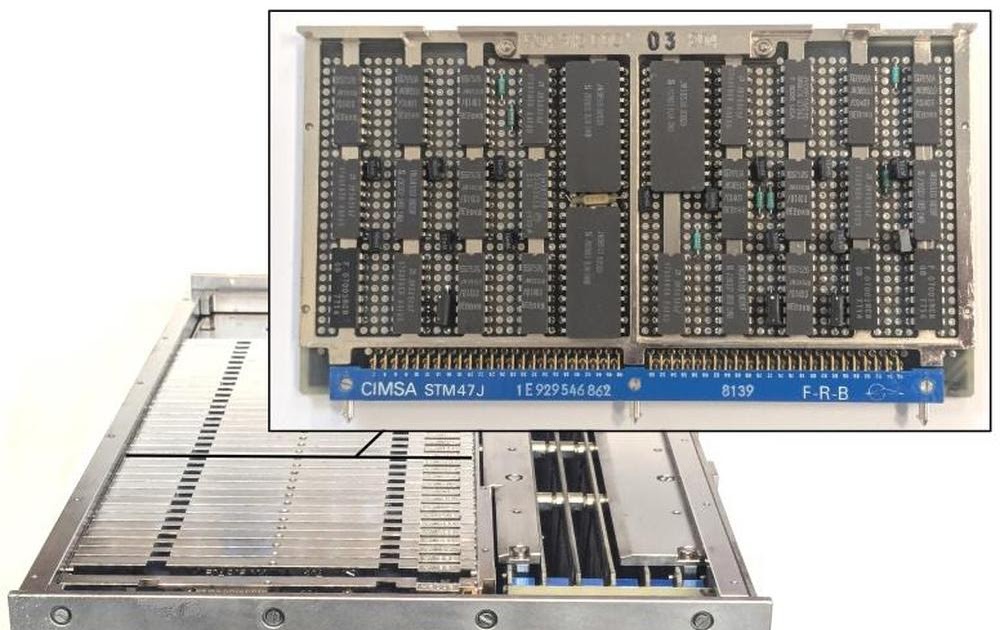
Reverse engineering the Mitra 125 MS: The French-built minicomputer that controlled Spacelab
This article details the reverse engineering of a processor board from the Mitra 125 MS minicomputer, which was used to control the Spacelab
 righto.com·1mo ago
Understanding x86-64 CPU Register Architecture: From 16 General-Purpose to Hundreds of Physical Registers
This technical article explores the complex register architecture of x86-64 CPUs, explaining that while the ISA defines 16 general-purpose r
 blog.yossarian.net·4mo ago
Debugging a Disappearing Service Processor in Oxide's Next-Gen Rack
Oxide Computer Company describes a challenging debugging scenario where their Service Processor (SP) would disappear from the management net
 oxide.computer·1mo ago
Comments
Sign in to join the conversation.
No comments yet. Be the first.