
























Dynestyx: A Probabilistic Programming Library for State-Space Models and Dynamical Systems
By
[Submitted on 15 Jun 2026]
Summary
The article introduces dynestyx, a probabilistic programming library designed specifically for state-space models (SSMs) used in Bayesian analysis of dynamical systems. It addresses the difficulty of incorporating dynamical systems into modern probabilistic programming languages (PPLs), making advanced Bayesian methods more accessible. The library provides a unified interface for specifying priors for discrete-time or continuous-time dynamical systems, performing inference over mixed-effect data, and producing state and parameter estimates with principled uncertainty quantification. Applications span statistics, signal processing, and machine learning.
Source

 Twitter / XDynestyx: A Probabilistic Programming Library for State-Space Models and Dynamical Systemsarxiv.org
Key quotes
· 3 pulledState-space models (SSMs) are the standard formalism for Bayesian treatment of dynamical systems, with natural applications in statistics, signal processing, and machine learning.
Despite their importance in both theory and application, dynamical systems have proven difficult to incorporate in modern probabilistic programming languages (PPLs), making state-of-the-art methods less accessible to practitioners and introducing friction in following the 'Bayesian workflow.'
Through a single, unified interface, users may specify arbitrary priors for discrete-time or continuous-time dynamical systems, perform inference over mixed-effect data, and make state and parameter estimates with principled uncertainty quantification.
You might also wanna read


Prandtl-consistent Kinetic Model for SBS: Beyond BGK
 calendar.tamu.edu·10d ago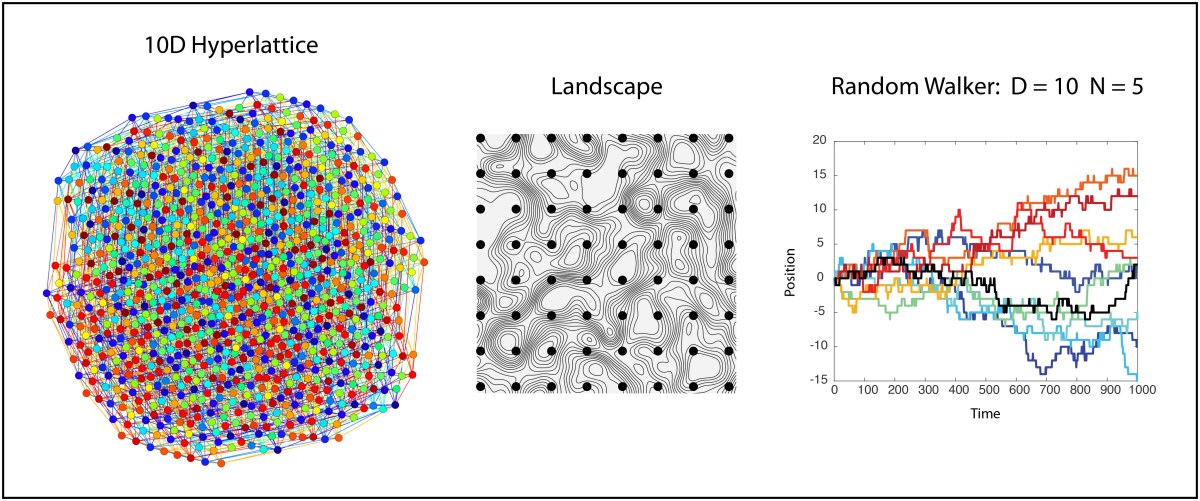
The Mathematics of Random Walks in High-Dimensional Spaces and Their Role in Deep Learning
The article explores the mathematics and physics of random walks in high-dimensional spaces, explaining how this concept underpins modern dy
 galileo-unbound.blog·10mo ago
Inferring stochastic dynamics by biophysical Neural ODE using single-cell transcriptomics

Machine Learning Reduces Computational Steps in Dynamical System Simulations
Researchers at EPFL, led by Filippo Bigi, have developed a machine learning approach that reduces the number of time steps needed in numeric
 physics.aps.org·23d ago
Kent Osband's "Rationally Turbulent Expectations" Explores Bayesian Learning with Calm and Turbulent Phases
Kent Osband summarizes his research on "rational turbulence" in a new book, building on work previously linked by the blog. The key finding

Statistical methods for analyzing ecological multinomial time series to identify environmental and biotic drivers of community change
This article presents statistical methods for analyzing ecological multinomial time series to disentangle the effects of environmental drive
 buff.ly·21d ago
Comments
Sign in to join the conversation.
No comments yet. Be the first.