
























JunoCam Global Maps Archive: Jupiter from Perijove Images
Summary
This article presents an archive of global maps created from JunoCam's color images of Jupiter, captured during each perijove (closest approach) of the Juno spacecraft's orbit. It describes how JunoCam operates — scanning a wide field of view in red, green, and blue strips during the spacecraft's rotation — and the technical process behind assembling these images into global maps of Jupiter.
Source

 Twitter / XJunoCam Global Maps Archive: Jupiter from Perijove Imagesmissionjuno.swri.edu
Key quotes
· 2 pulledJuno is in a highly elliptical, near-polar orbit, so on each orbit JunoCam takes well-resolved images within just a few hours around closest approach, which is called perijove (PJ).
As Juno is moving very rapidly at that time, the camera scans a 58-degree-wide field of view in narrow red, green and blue strips, and a single image is assembled from a long sequence of these strips taken during one rotation of the spacecraft at 2 rpm.
You might also wanna read

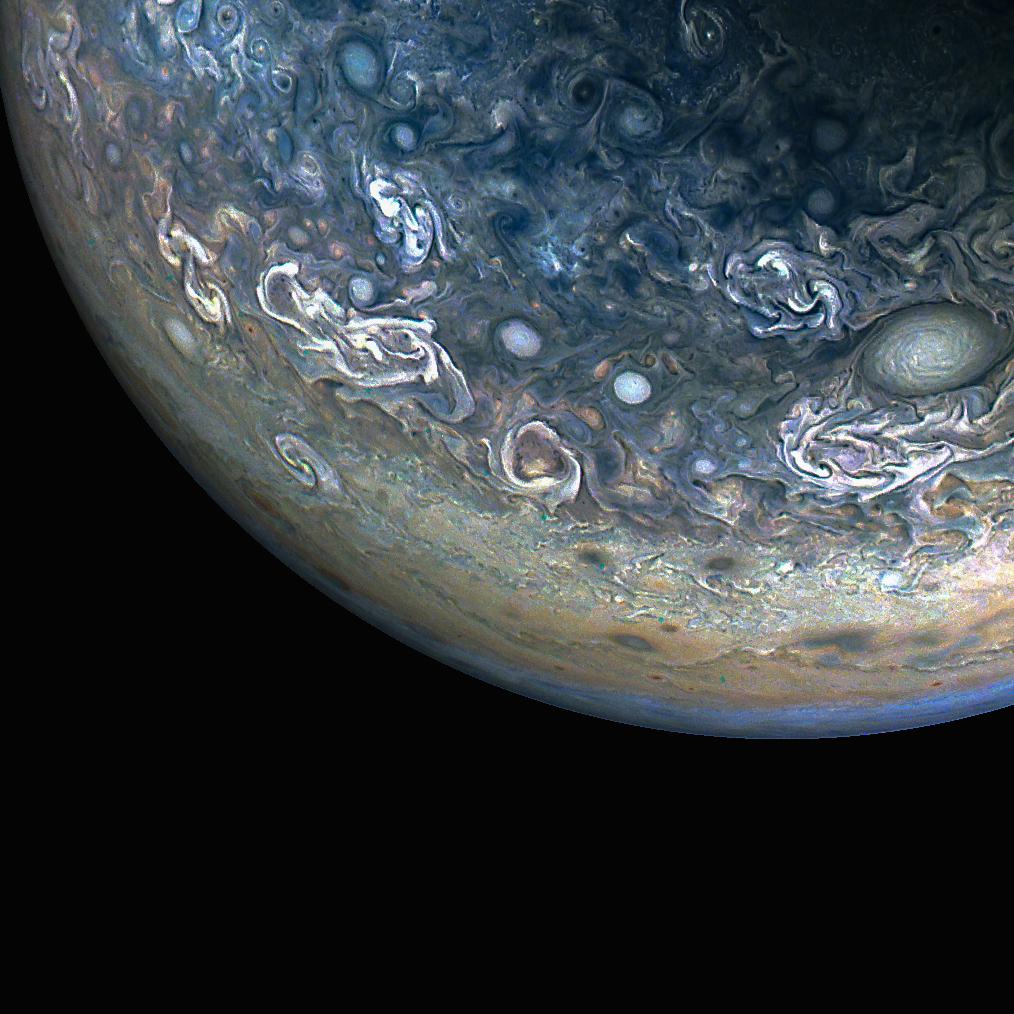
Juno spacecraft captures color-enhanced view of Jupiter's northern hemisphere during 61st flyby
NASA's Juno spacecraft captured a color-enhanced image of Jupiter's northern hemisphere during its 61st close flyby on May 12, 2024. Citizen
 nasa.gov·1mo ago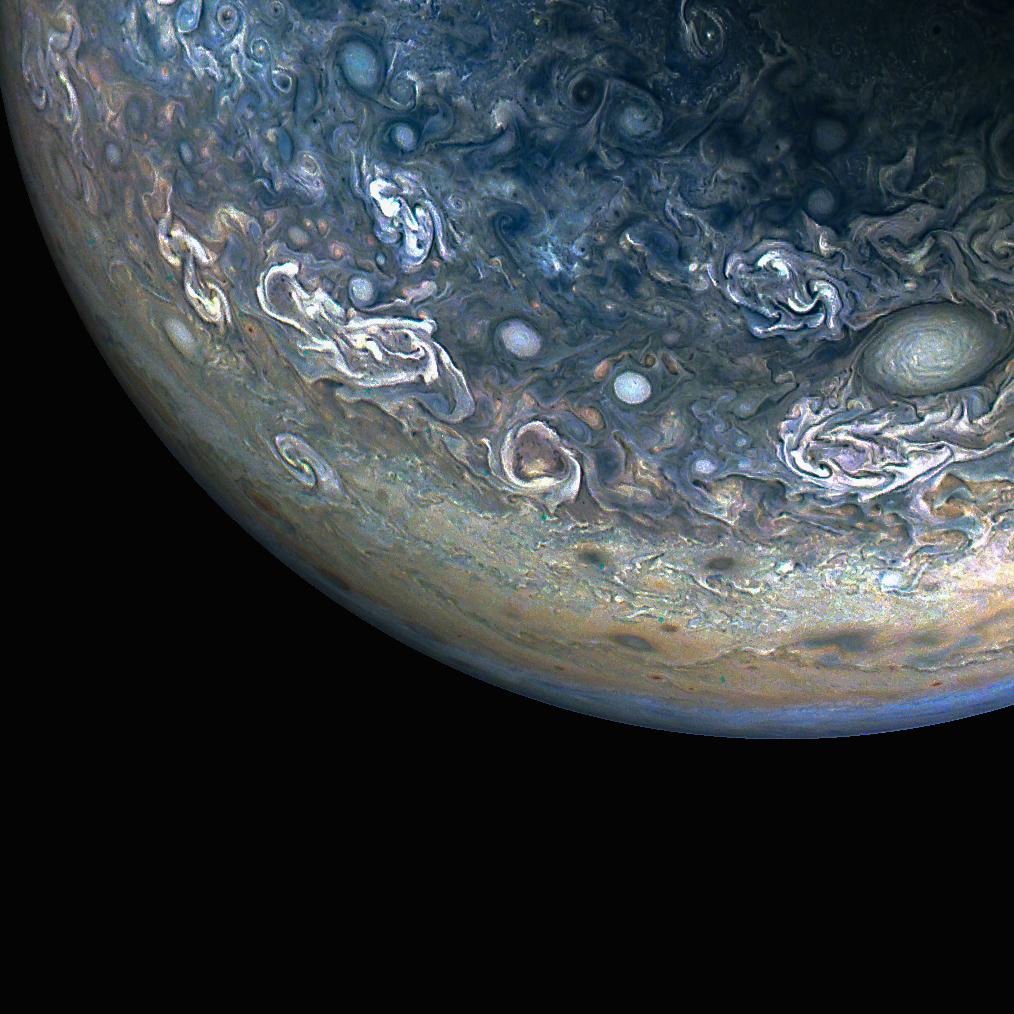
Juno Spacecraft Captures Color-Enhanced View of Jupiter's Northern Hemisphere
NASA's Juno spacecraft captured a color-enhanced image of Jupiter's northern hemisphere during its 61st close flyby on May 12, 2024. The ima
nasa.gov·28d ago
China's JUNO neutrino detector releases first major results with precise measurements of particle flavor-switching
China's Jiangmen Underground Neutrino Observatory (JUNO) has released its first major results, making some of the most precise measurements
 apnews.com·23d ago
China's Jiangmen Underground Neutrino Observatory Releases First Major Findings on Neutrinos
The Jiangmen Underground Neutrino Observatory (JUNO) in China has released its first major findings on neutrinos—tiny cosmic particles from
 sciencealert.com·21d ago
Curiosity Rover Blog: Planning Exploration Routes Based on Martian Surface Textures (Sols 4927–4933)
A blog post from NASA's Curiosity Mars rover mission, written by a planetary mineralogy professor. It describes the rover's current explorat
 science.nasa.gov·11d ago
Vera C. Rubin Observatory begins decade-long survey of the changing night sky with world's largest digital camera
The Vera C. Rubin Observatory in Chile has begun a 10-year survey of the night sky using the world's largest digital camera. The telescope w
 science.org·5d ago
Comments
Sign in to join the conversation.
No comments yet. Be the first.