
























A physicist investigates whether sand and other physical materials can learn
Summary
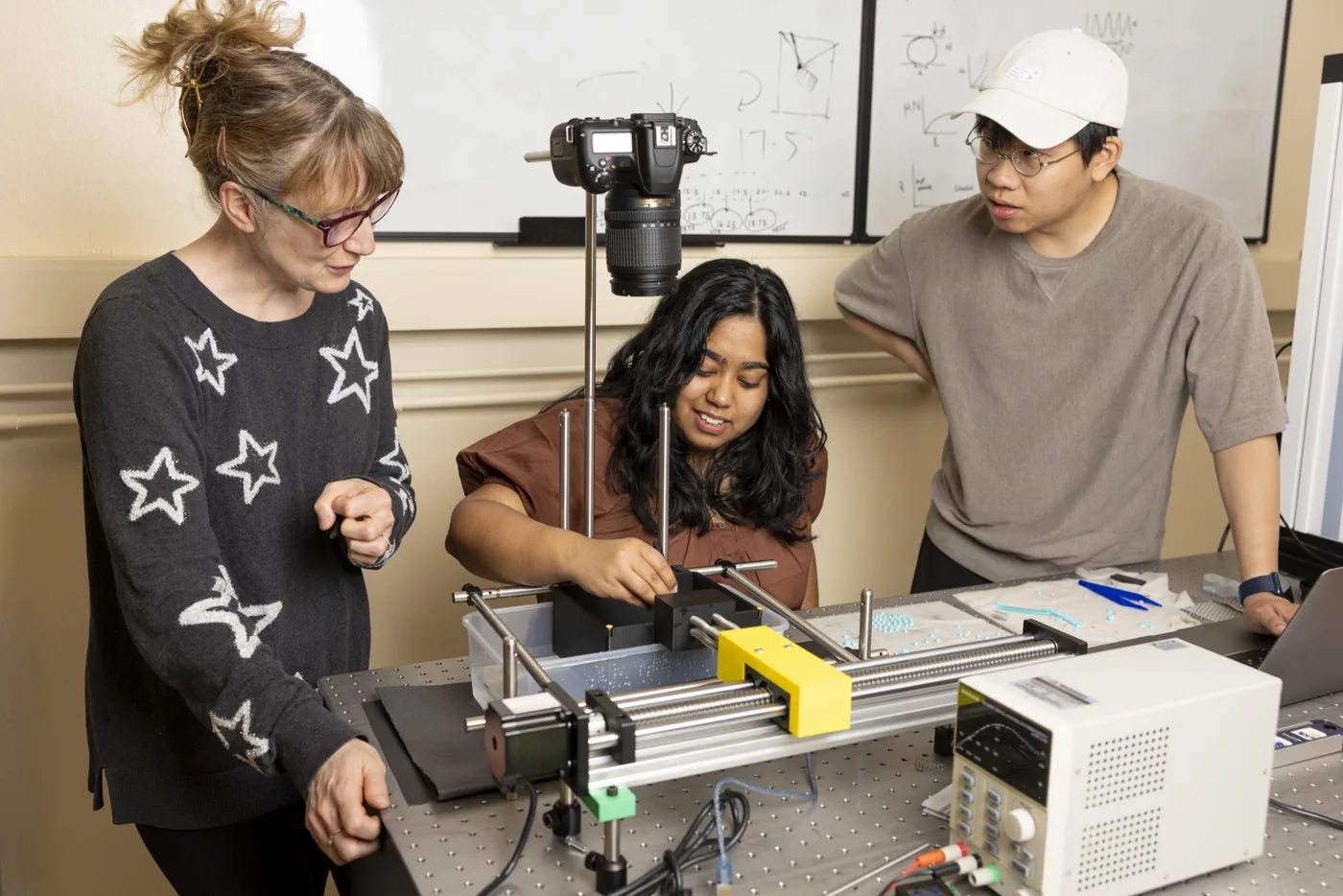
Theoretical physicist Jennifer Schwarz, a professor at Syracuse University, explores the hypothesis that learning and information processing are not limited to biological brains but can occur in physical systems like sand, cells, and tissues. Her research at the intersection of physics and biology investigates how collections of simple components — from grains of sand to cellular networks — can exhibit memory, adaptation, and learning-like behaviors through their physical interactions and structural changes. The article examines her unconventional approach, her farm-based laboratory of natural phenomena, and the broader implications for understanding intelligence, computation, and the nature of learning itself.
Source
 bskyA physicist investigates whether sand and other physical materials can learnsyracuse.edu
Key quotes
· 3 pulledThe place offers a crash course in natural phenomena. It shows me how small, individual parts interact to create complex behaviors.
We tend to think of learning as something that happens in brains, but what if it's a more fundamental property of matter?
If sand can learn, then the boundaries between the living and non-living start to blur in fascinating ways.
You might also wanna read


Physics of Learning: A Scientific Collaboration to Understand AI's Fundamental Principles
This article introduces a research collaboration focused on understanding the fundamental scientific principles underlying artificial intell
 physicsoflearning.org·1d ago
At the Mysterious Boundary Between Waking Life and Sleep, What Happens in the Brain?

Exploring Fluid Mechanics Concepts Through Real-Time Thinking and Problem-Solving
The article presents a personal exploration of fluid mechanics concepts, written as a real-time thinking trace over several hours. The autho
 tsvibt.blogspot.com·4mo ago
Neuroscientist challenges decades-old model of how vision and thinking work in the brain
Neuroscientist Nuttida Rungratsameetaweemana is challenging the long-held conventional view that vision is a passive, feed-forward process w
 engineering.columbia.edu·4d ago
Neuroscientist challenges decades-old model of how vision and thinking work in the brain
Neuroscientist Nuttida Rungratsameetaweemana is challenging the long-held conventional view that vision is a passive, feed-forward process w
engineering.columbia.edu·4d ago
Emerging Scientific Theory of Deep Learning: The Case for "Learning Mechanics"
This academic paper argues that a scientific theory of deep learning is emerging, which the authors call "learning mechanics." They identify
 arxiv.org·2mo ago
Shiitake Mushroom Mycelium Used to Create Sustainable Memristors for Neuromorphic Computing
Researchers have developed sustainable memristors using shiitake mushroom mycelium for high-frequency bioelectronics applications. The study
 journals.plos.org·8mo ago
Comments
Sign in to join the conversation.
No comments yet. Be the first.