
























Business World Model: An AI Architecture for Autonomous Strategic Decision-Making in Organizations
By
[Submitted on 8 Jun 2026]
Summary
This paper introduces the concept and architecture of a Business World Model (BWM), a specialized world model for business environments that enables AI systems to plan, optimize, and execute business initiatives from high-level strategic objectives. Inspired by world models in AI, cognitive science, and control theory, the BWM encodes business states, dynamics, constraints, objectives, and feasible action spaces to support autonomous decision-making. The proposed architecture integrates semantic data representations, probabilistic machine learning models, deterministic business rules, and explicit action spaces into a coherent structure for planning and counterfactual reasoning. The key contribution is organizing these components as an executable internal simulator for business initiatives, moving from instruction-based execution toward goal-driven planning and execution.
Source

 bskyBusiness World Model: An AI Architecture for Autonomous Strategic Decision-Making in Organizationsarxiv.org
Key quotes
· 5 pulledThe transformative potential of AI extends beyond automating predefined tasks: it lies in enabling intelligent systems to plan, optimize, and execute business initiatives from high-level strategic objectives.
This paper introduces the concept and architecture of a business world model (BWM), a world model specialized for business and organizational environments.
The proposed architecture integrates semantic data representations, probabilistic machine learning models, deterministic business rules, and explicit action space into a coherent structure for planning and counterfactual reasoning.
The contribution of BWM lies in organizing them as an executable internal simulator for business initiatives.
This work establishes a conceptual foundation for autonomous business systems capable of moving from instruction-based execution toward goal-driven planning and execution.
You might also wanna read


Qwen-AgentWorld: Language World Models for Simulating Agentic Environments Across 7 Domains
This paper introduces Qwen-AgentWorld, a family of language world models (35B-A3B and 397B-A17B) designed to simulate agentic environments a
arxiv.org·1d ago
World Models Make a Comeback in Artificial Intelligence Research
The article discusses the resurgence of 'world models' in AI research, where AI systems develop internal representations of their environmen
 quantamagazine.org·9mo ago
Context as the Competitive Advantage in an AI-First Society
The article discusses the author's experience at an AI Socratic Madrid meetup and presents a thesis that in the AI-first society, intelligen
 adlrocha.substack.com·3mo ago
Critique of the Agent Model: Distinguishing Automation from Genuine Agency in AI Systems
This paper critiques the current AI agent landscape, distinguishing between mere automation and genuine agency. Drawing on Descartes' philos
arxiv.org·8h agoCritique of the Agent Model: Distinguishing Automation from Genuine Agency in AI Systems
This paper critiques the current AI agent landscape, distinguishing between mere automation and genuine agency. Drawing on Descartes' philos
arxiv.org·8h ago
Survey of Self-Evolving AI Agents: Bridging Foundation Models and Lifelong Adaptability
The article surveys the emerging field of self-evolving AI agents, which aim to bridge the static capabilities of foundation models with the
arxiv.org·10mo ago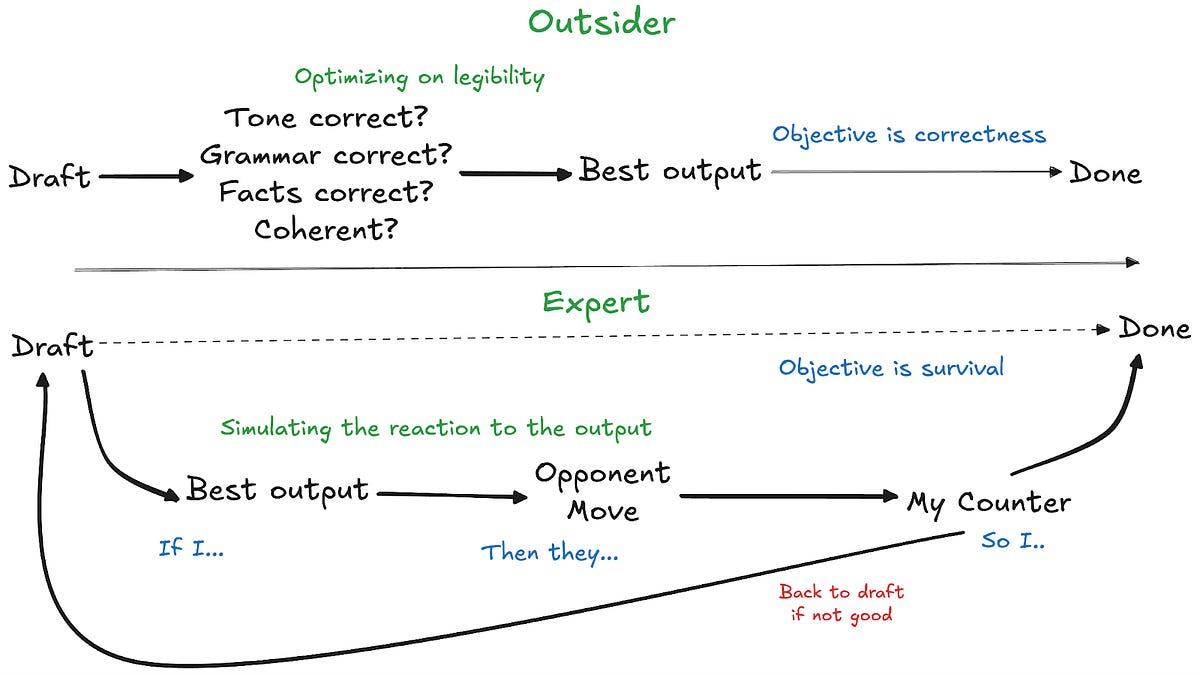
The Gap Between Expert World Models and LLM Word Models: Why AI Needs Better Reasoning Systems
The article discusses the distinction between expert world models and LLM word models, arguing that true expertise involves understanding co
 latent.space·4mo ago
Comments
Sign in to join the conversation.
No comments yet. Be the first.