
























GRMHD simulations explore black hole accretion variability in X-ray binary transients
By
Chloe Klare
Summary
This article discusses GRMHD (General Relativistic Magnetohydrodynamic) simulations of black hole accretion flows, specifically examining variability in X-ray binary systems where one star is a black hole. The research, published in MNRAS by Raha, Mukhopadhyay, and Chatterjee from the Indian Institute of Science, explores initial conditions needed to reproduce observational characteristics in hard state X-ray binary transients. The paper investigates whether black hole accretion must be SANE (Standard And Normal Evolution) or MAD (Magnetically Arrested Disk), suggesting there may be more nuance to these classifications.
Source

 bskyGRMHD simulations explore black hole accretion variability in X-ray binary transientsastrobites.org
Key quotes
· 2 pulledTrying to figure out the right initial conditions to reproduce the observational characteristics in your favorite X-ray binary (XRB which differs from your run-of-the mill binary star system in that one of the stars is a black hole instead, which is responsible for the eponymous X-rays) is a lot
Black hole accretion must be SANE or MAD, right? Maybe not...read to learn more!
You might also wanna read


How MIT astrophysicist Erin Kara studies black hole echoes to understand galaxy formation
MIT Associate Professor Erin Kara studies black holes not as dark voids but as extremely dense objects that warp space-time and generate mas
 news.mit.edu·9d ago
Chandra Observatory reveals surprising X-ray brightness variations in supernova remnants of galaxy M83
NASA's Chandra X-ray Observatory data spanning over 14 years reveals that more than 20 previously identified supernova remnants in the galax
Astrophysicists Test Einstein's 'No-Hair Theorem' on Black Holes Using Collision Data
Astrophysicists are testing Einstein's 'no-hair theorem' which states that black holes are defined only by mass and spin, with no other dist
 quantamagazine.org·10mo ago
Einstein Probe may have caught a black hole tearing apart a white dwarf for the first time
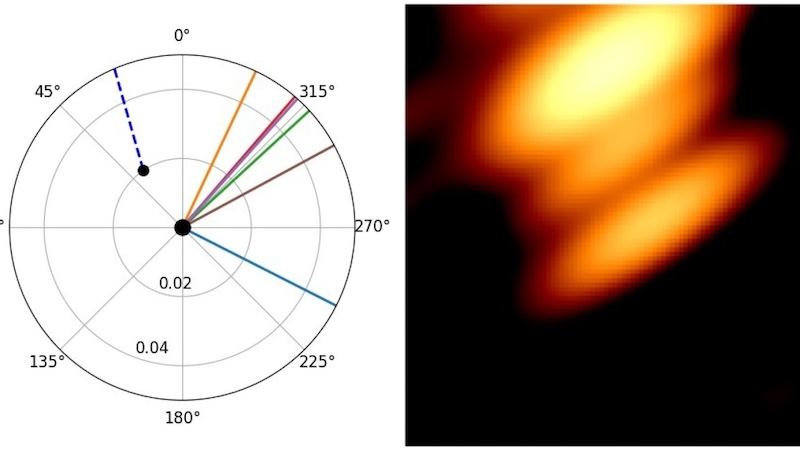
First Image Captured of Two Black Holes Orbiting Each Other in Distant Quasar
Scientists have captured the first confirmed image of two black holes orbiting each other in quasar OJ287, located five billion light-years
 helsinkitimes.fi·8mo ago
Astronomers Discover Most Distant and Powerful Black Hole Flare from Star Destruction
Astronomers have discovered the most powerful and distant flare of energy ever recorded from a supermassive black hole, likely caused by a m
 caltech.edu·8mo ago
Comments
Sign in to join the conversation.
No comments yet. Be the first.