
























Thermodynamic neurons enable interpretable rule-based machine learning through heat flow
By
[Submitted on 24 Jun 2026]
Summary
This paper presents a novel machine learning architecture that uses thermodynamic neurons — autonomous quantum thermal machines — to implement logical operations through heat flow. The researchers construct a stochastic version of the Tsetlin machine, an interpretable rule-based learning system, using thermodynamic AND, NOT and OR gates with an autonomous coupling mechanism. Despite operating with noisy components, the classifier achieves accuracy statistically comparable to standard Tsetlin machines, with reliability arising from architectural mechanisms like thresholding and redundancy rather than exact logical operations. The work demonstrates that accurate and interpretable learning can emerge from autonomous stochastic dynamics.
Source

 bskyThermodynamic neurons enable interpretable rule-based machine learning through heat flowarxiv.org
Key quotes
· 5 pulledWe turn these physical effects into computational resources for an autonomous, interpretable learning architecture.
We develop a classifier based on thermodynamic neurons, which are autonomous quantum thermal machines that implement logical operations through heat flow.
Despite its noisy components, the resulting classifier achieves classification accuracy that is statistically comparable to that of the standard Tsetlin machine.
Reliability arises from architectural mechanisms such as thresholding and redundancy, rather than exact logical operations.
Our results highlight that accurate and interpretable learning can emerge from autonomous stochastic dynamics, and establish thermodynamic computation as a viable framework for physical machine learning.
You might also wanna read


Our paper on Denoising Thermodynamic Models is now published in Nature's npj Unconventional Computing. We demonstrate thermodynamic hardware built on the primitives validated in X0 could unlock genera
Our paper on Denoising Thermodynamic Models is now published in Nature's npj Unconventional Computing. We demonstrate thermodynamic hardware built on the primitives validated in X0 could unlock genera
Experimental Sampling of LLaMA Language Model at Negative Temperature Yields Bizarre Results
This article explores an experimental approach to sampling language models (specifically LLaMA) at negative temperatures, inspired by statis

Extropic Develops Thermodynamic Computing Hardware for Energy-Efficient AI Processing
Extropic is developing thermodynamic computing hardware designed to be significantly more energy efficient than GPUs for AI workloads. The c

Universal Constraint Engine: Generating Emergent Neuromorphic Architectures from Declarative Rules
The article introduces the Universal Constraint Engine (UCE), a novel system that generates emergent multi-state architectures from declarat
 zenodo.org·2mo ago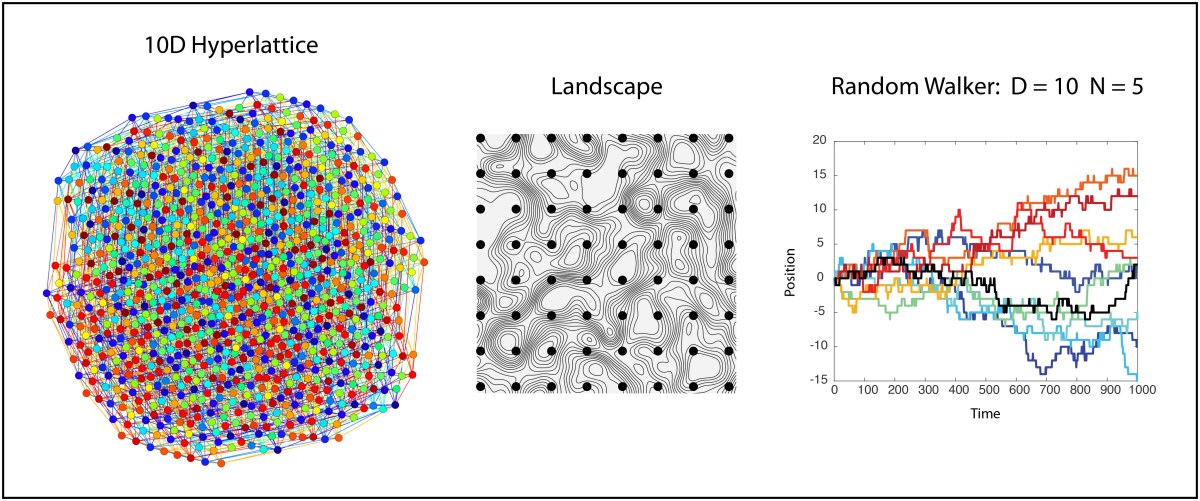
The Mathematics of Random Walks in High-Dimensional Spaces and Their Role in Deep Learning
The article explores the mathematics and physics of random walks in high-dimensional spaces, explaining how this concept underpins modern dy
 galileo-unbound.blog·10mo ago
Comments
Sign in to join the conversation.
No comments yet. Be the first.