
























JWST reveals asymmetric cloud cycle on hot Jupiter exoplanet WASP-94A b
By
Isabelle Dumé
Summary
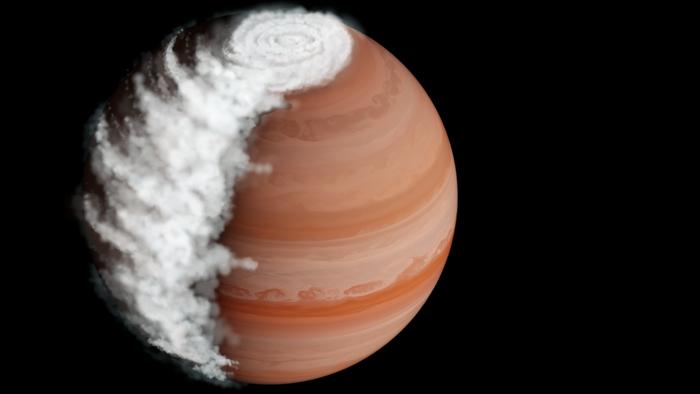
New observations from the James Webb Space Telescope (JWST) of the hot Jupiter exoplanet WASP-94A b reveal an asymmetric weather pattern that provides unprecedented insight into the planet's atmosphere. The study shows a daily cloud cycle where clouds build on the planet's dark side and dissipate on the dayside, offering a much clearer understanding of cloud dynamics on a distant world located nearly 700 light-years from Earth.
Source
 bskyJWST reveals asymmetric cloud cycle on hot Jupiter exoplanet WASP-94A bphysicsworld.com
Key quotes
· 3 pulledClouds build as air flows over the dark side of the planet, reaching a large swell by daybreak.
The clouds dissipate on the dayside, leaving clear skies in the early evening.
New 'transit' observations of the hot Jupiter exoplanet WASP-94A b using the James Webb Space Telescope provide a much clearer understanding of clouds on a distant world.
You might also wanna read


Candidate Giant Planet Detected in Habitable Zone of α Cen A via JWST Observations
The article reports on coronagraphic observations of the star α Cen A using the James Webb Space Telescope's MIRI instrument. A candidate gi
 arxiv.org·10mo ago
James Webb Space Telescope Captures First Direct Image of Exoplanet
The James Webb Space Telescope has captured its first direct image discovery of an exoplanet by identifying the infrared light of a likely p
smithsonianmag.com·1y ago
JWST Study Reveals Exoplanet GJ 3929b as Likely Bare Rock Without Atmosphere
The James Webb Space Telescope's Rocky Worlds program has revealed that exoplanet GJ 3929b is likely a bare rock with no significant atmosph
arxiv.org·10mo ago
JWST reveals unusual chemical signatures in interstellar comet 3I/ATLAS
NASA researchers using the James Webb Space Telescope are investigating the origins of interstellar comet 3I/ATLAS, discovered on July 1, 20
 space.com·21h ago
JWST Discovers Mysterious 'Little Red Dots' in Early Universe, Possibly New Celestial Objects
NASA's JWST telescope has discovered hundreds of 'little red dots' in the early universe, which may represent a new type of celestial object
 science.org·10mo ago
Astronomers Directly Image Third Giant Exoplanet in β Pictoris System
Astronomers report the direct imaging discovery of β Pictoris d, a third exoplanet in the β Pictoris system. The planet was detected using n
 astrobiology.com·21h ago
Comments
Sign in to join the conversation.
No comments yet. Be the first.