

























Boston Children's Hospital uses OpenAI's o3 model to diagnose rare genetic diseases in children
By
Jared Perlo
Summary
Boston Children's Hospital researchers, in collaboration with OpenAI, published a study in NEJM AI demonstrating that off-the-shelf AI tools (specifically OpenAI's o3 model) can help identify genetic errors causing rare diseases in children. The AI successfully identified 18 diagnoses for pediatric patients with rare illnesses who had previously gone undiagnosed, offering a promising new approach to diagnosing conditions that traditional methods miss.
Source

 bskyBoston Children's Hospital uses OpenAI's o3 model to diagnose rare genetic diseases in childrennbcnews.com
Key quotes
· 3 pulledOver a thousand children visit Boston Children’s Hospital every day. Many get clear diagnoses and begin treatment, but a small subset of pediatric visitors with rare illnesses never get diagnoses at all.
New research from the hospital’s center for rare diseases and the AI company OpenAI reveals that off-the-shelf AI tools can help identify which errors in patients’ genomes might be causing the children’s diseases.
The findings, announced Thursday in the New England Journal of Medicine’s AI-focused publication, NEJM AI, show that OpenAI’s o3 Deep Research model can assist in diagnosing rare conditions.
You might also wanna read

AI tools help diagnose 18 children with previously undiagnosed rare diseases, Boston Children's Hospital study finds
New research from Boston Children's Hospital demonstrates that AI tools successfully diagnosed 18 children with previously undiagnosed rare
 nypost.com·16h ago
Harvard study finds AI outperforms doctors in emergency triage diagnoses
A Harvard study found that AI systems outperformed human doctors in emergency medicine triage, diagnosing more accurately in high-pressure s
 The Guardian·1mo ago
OpenAI Considers Revenue-Sharing Model for Customer AI-Assisted Discoveries
OpenAI is reportedly developing a new business model where it would take a percentage share of revenue from customer innovations and discove
 news.aibase.com·5mo ago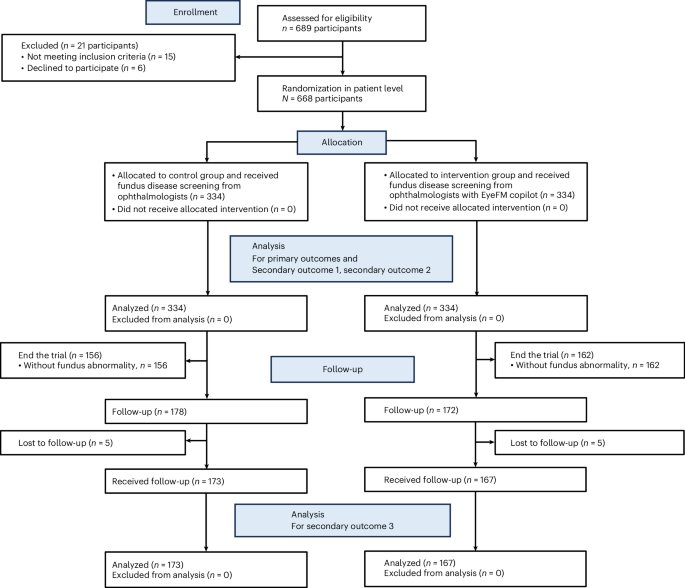
AI Foundation Model Improves Ophthalmologist Diagnostic Accuracy in Randomized Controlled Trial
Researchers developed EyeFM, a multimodal vision-language eyecare foundation model trained on 14.5 million ocular images from global dataset
 nature.com·9mo ago
Study Finds AI Toys for Young Children Need Stricter Regulations Due to Interaction Limitations
Cambridge researchers conducted the first study of AI toys for young children, finding that current AI toys like Gabbo (which uses OpenAI's
 bbc.co.uk·3mo ago
OpenAI and Retro Biosciences Develop AI Model That Achieves 50x Improvement in Stem Cell Reprogramming
OpenAI collaborated with Retro Biosciences to develop GPT-4b micro, a specialized AI model for protein engineering. The AI-designed proteins
 openai.com·9mo ago
Comments
Sign in to join the conversation.
No comments yet. Be the first.