
























Adaptive Double-Subspace Signal Detection in Homogeneous and Partially Homogeneous Environments
26d ago
Source
IEEEAdaptive Double-Subspace Signal Detection in Homogeneous and Partially Homogeneous Environmentsieee.orgThe double-subspace (DOS) signal model is general to describe various signals, for which several detectors have been proposed in the literature. However, some detectors obtained in previous work hold true only for special cases. In this paper, we reconsider the problems of DOS signal detection in homogeneous environment and partially homogeneous environment (PHE). The correct signal coordinate matrices are derived under the general DOS framework, and the corresponding parameters are obtained as well. The generalized likelihood ratio test (GLRT), Wald test, gradient test, and a type of spectral norm test in PHE are developed, and the GLRT and gradient test in HE coincide with existing ones. The constant alarm rate properties of the designed detectors are established and verified by numerical examples. Simulations are conducted to show that the proposed GLRT and gradient test in PHE perform better in some scenarios.
You might also wanna read


Limitations and improvements of chain rules for conditional entropies in quantum cryptography security proofs
This article discusses chain rules for conditional entropies in quantum cryptography, which are essential for security proofs against genera
 arxiv.org·1mo ago
High Performance Image Sensor Processing Using FPGA [pdf]
oda.uni-obuda.hu·1y ago

Deep Neural Networks Converge to Universal Low-Dimensional Subspaces Across Diverse Tasks
This research article presents empirical evidence that deep neural networks trained on diverse tasks converge to remarkably similar low-dime
arxiv.org·7mo agoIntroduction to the concept of likelihood and its applications (2018)
journals.sagepub.com·8mo ago

Chinese research team develops HG-STR algorithm for autonomous drone swarm targeting
Chinese researchers have developed a new algorithm called HG-STR (Heterogeneous Graph Spatio-Temporal Reasoning) that enables drone swarms t
 scmp.com·1mo ago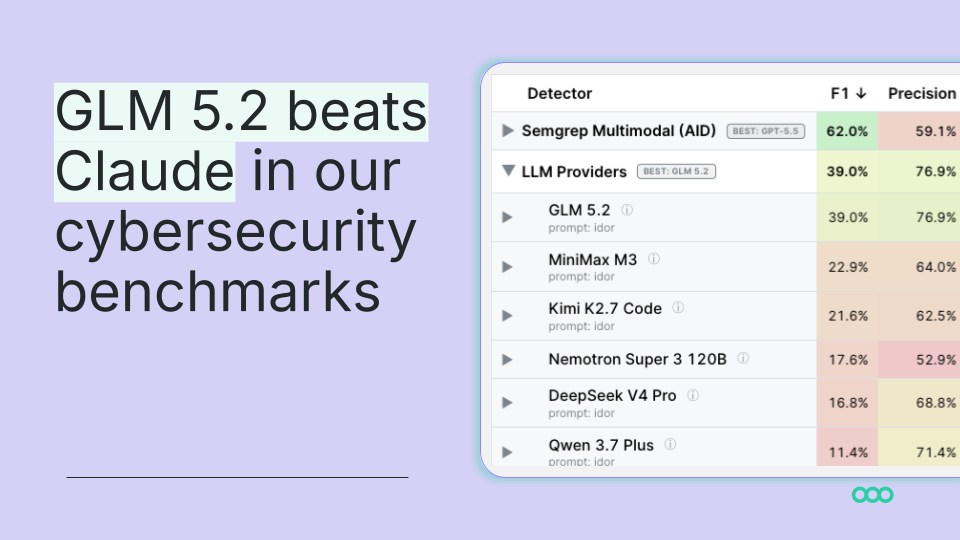
GLM 5.2 Open-Weight Model Beats Claude Code on IDOR Detection Benchmark at Lower Cost
Zhipu AI's open-weight GLM 5.2 model outperformed Claude Code (39% vs 32% F1) on an IDOR (Insecure Direct Object Reference) detection benchm
 semgrep.dev·1d ago
Comments
Sign in to join the conversation.
No comments yet. Be the first.