
























Acute versus Long-term anti-GPVI Treatment: From Receptor Blockade to Partial Downregulation
By
Stefano Navarro
6h agoen
Source
communities.springernature.comAcute versus Long-term anti-GPVI Treatment: From Receptor Blockade to Partial Downregulationspringernature.comWhile targeting GPVI with inhibitory Fab fragments is effective and safe in acute preclinical disease settings, it is not suitable for long-term treatment. We now show that partial GPVI downregulation by low-affinity IgGs provides safe, long-term protection from thrombosis and thrombo-inflammation.
You might also wanna read
https://doi.org/10.1056/NEJMoa2517384
doi.org·1mo ago


Realizing the potential of agonistic antibody immunotherapy
doi.org·16d ago

Computational Design of Peptide Masks Enables Conditionally Active Miniprotein Therapeutics
This article presents a novel computational approach for designing conditionally active miniprotein binders through de novo peptide masks. T
 pubs.acs.org·11d ago
Phase 1 trial finds triple monoclonal antibody combination safe and effective for HIV-1 prevention
This phase 1, multicentre, randomised, open-label trial (HVTN 140/HPTN 101 part B) evaluated the safety, pharmacokinetics, and neutralisatio
thelancet.com·6d ago

Antibody-ligand motif optimization enables multitarget switchable CAR-T therapy against solid tumors
This article presents a research study on optimizing a multitarget switchable CAR-T (sCAR-T) strategy to overcome antigenic heterogeneity an
cell.com·11d ago
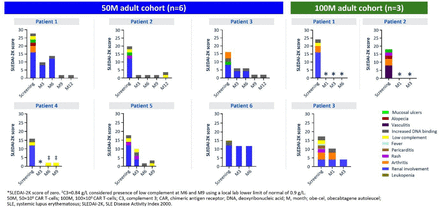
Phase I CARLYSLE study: CAR T-cell therapy obe-cel shows favorable safety and clinical benefit in severe refractory lupus
This article reports initial results from the phase I CARLYSLE study evaluating obecabtagene autoleucel (obe-cel), a CD19-targeting CAR T-ce
 lupus.bmj.com·26d ago
Comments
Sign in to join the conversation.
No comments yet. Be the first.