
























JWST Reveals WASP-39b Has Cloudy Mornings and Clear Evenings, Solving Longstanding Exoplanet Mystery
By
Javier Barbuzano
Summary
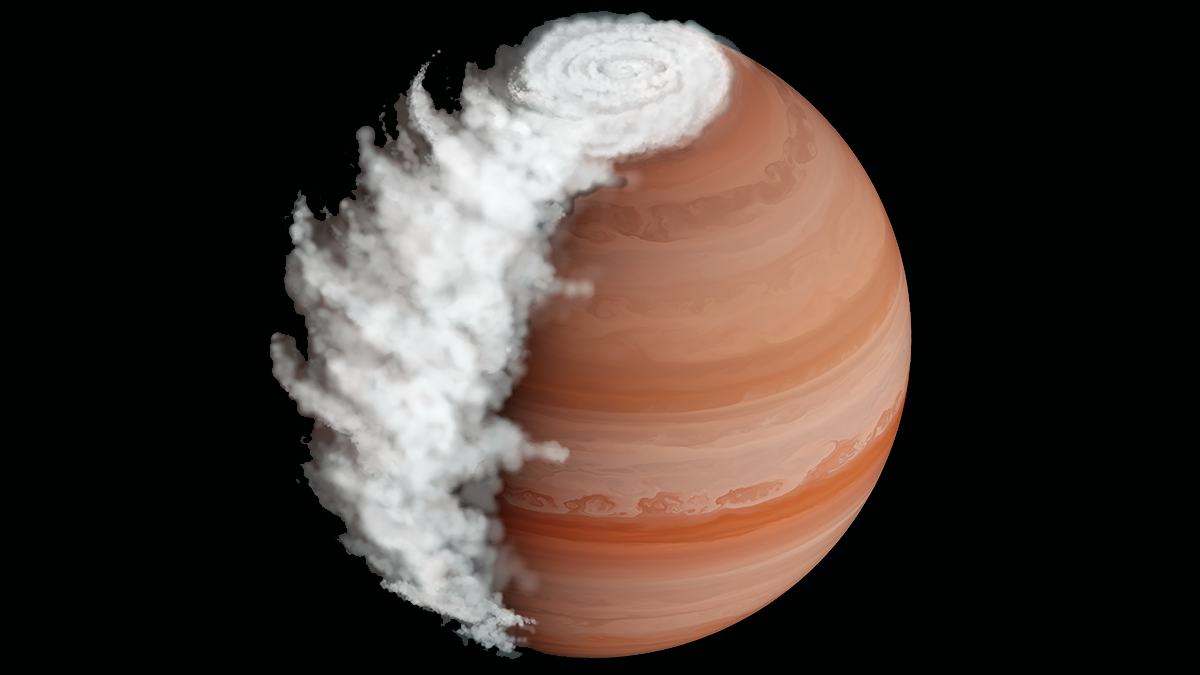
Astronomers using the James Webb Space Telescope (JWST) have developed a novel observation technique to study the exoplanet WASP-39b, a hot Jupiter located 700 light-years away. By observing the planet at different orbital phases (morning, evening, and noon), they discovered that the planet has cloudy mornings and clear evenings. This asymmetry explains why previous observations over the past 20 years produced inconsistent data about the planet's chemical composition. The study reveals that the planet's terminator (the boundary between day and night) has different conditions on each side, with the morning side being cooler and cloudier while the evening side is hotter and clearer. This breakthrough helps clarify more than a decade of blurry data about exoplanet atmospheres and demonstrates a new method for studying distant worlds.
Source
 bskyJWST Reveals WASP-39b Has Cloudy Mornings and Clear Evenings, Solving Longstanding Exoplanet Mysteryeos.org
Key quotes
· 3 pulledClear skies are important for astronomers—not just here on Earth but also on the alien planets they are looking at.
For the past 20 years, scientists studying exoplanets have been literally blinded by fog.
This overcast condition acts like a fogged-up window, blocking telescopes from getting a clear reading of the planets' true composition.
You might also wanna read


JWST Study Reveals Exoplanet GJ 3929b as Likely Bare Rock Without Atmosphere
The James Webb Space Telescope's Rocky Worlds program has revealed that exoplanet GJ 3929b is likely a bare rock with no significant atmosph
 arxiv.org·10mo ago
Candidate Giant Planet Detected in Habitable Zone of α Cen A via JWST Observations
The article reports on coronagraphic observations of the star α Cen A using the James Webb Space Telescope's MIRI instrument. A candidate gi
arxiv.org·10mo ago
James Webb Space Telescope Captures First Direct Image of Exoplanet
The James Webb Space Telescope has captured its first direct image discovery of an exoplanet by identifying the infrared light of a likely p
smithsonianmag.com·1y ago
JWST Discovers Mysterious 'Little Red Dots' in Early Universe, Possibly New Celestial Objects
NASA's JWST telescope has discovered hundreds of 'little red dots' in the early universe, which may represent a new type of celestial object
 science.org·10mo ago
JWST reveals unusual chemical signatures in interstellar comet 3I/ATLAS
NASA researchers using the James Webb Space Telescope are investigating the origins of interstellar comet 3I/ATLAS, discovered on July 1, 20
 space.com·21h ago
Isotopic Evidence for a Cold and Distant Origin of the Interstellar Object 3I/ATLAS
arxiv.org·3mo agoComments
Sign in to join the conversation.
No comments yet. Be the first.