
























39 design principles for building effective human-AI interactions
By
Taras Bakusevych
Summary
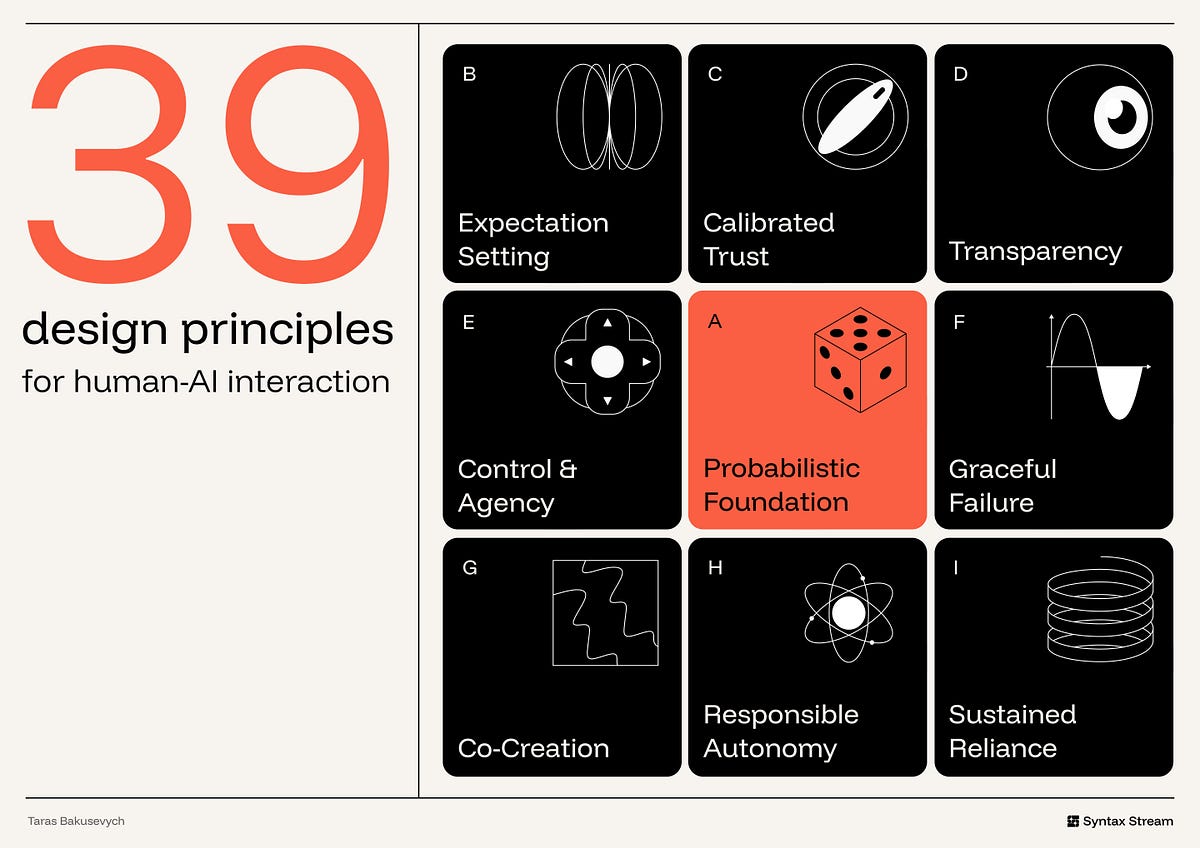
A comprehensive framework of 39 design principles for human-AI interaction, addressing the unique challenges AI systems pose compared to traditional deterministic interfaces. The framework covers four key areas: supporting appropriate reliance (helping users calibrate trust), ensuring user control and agency, maintaining transparency about system capabilities and limitations, and designing for responsible autonomy. The principles provide practical guidance for product designers and developers building AI-powered interfaces, with emphasis on helping users understand what AI systems can and cannot do, managing expectations, and creating safe, effective interactions.
Source
 Sidebar39 design principles for building effective human-AI interactionsuxdesign.cc
Key quotes
· 3 pulledAI systems are less deterministic. They introduce a property that most interface conventions weren't designed for: the same input can produce different outputs.
The same model can feel useful, confusing, or dangerous depending on the interface and instructions around it — product quality is not just about the model.
Traditional interfaces are built around predictable behavior. A control has a defined function. A workflow has known states. Errors can be anticipated and recovered from.
You might also wanna read


Practical UX Design Patterns for Building Trustworthy Agentic AI Systems
The article provides practical UX design patterns and frameworks for building agentic AI systems that prioritize user control, consent, and
 Smashing Magazine·4mo ago
Designing for AI Agents and Humans: Rethinking the Concept of "User" in Interface Design
The article explores how AI agents are increasingly interacting with digital interfaces alongside human users, challenging traditional UX de
 nngroup.com·21d ago
Designing Trustworthy AI Systems: Practical Methods for Building User Confidence
This article explores the critical importance of trust in AI systems, particularly as generative AI becomes integrated into digital products
Smashing Magazine·9mo ago
Design Patterns For Building Better AI Interfaces: A Practical Overview
This article provides a practical overview of design patterns for building AI interfaces and features in products. It addresses the challeng
Smashing Magazine·11mo ago
Practical Guide to Explainable AI for UX Designers: Building Trust Through Transparency
This article focuses on practical approaches to Explainable AI (XAI) for UX practitioners, emphasizing that XAI is not just a technical chal
Smashing Magazine·7mo ago
Human-AI Collaboration: Coherence, Responsibility, and Jean-Pol Martin's Framework for Optimal Partnership
This working paper examines the human conditions required for productive collaboration with artificial intelligence. It argues that AI does
 zenodo.org·23d ago
Comments
Sign in to join the conversation.
No comments yet. Be the first.