
























How to Form the Future Tense in English: Will vs. Going To — A Complete Grammar Guide
A comprehensive English grammar guide explaining how to form and use the future tense with 'will' and 'going to'. The article covers the structure of 'will' (modal verb + bare infinitive), its uses for predictions, spontaneous decisions, promises, and offers, as well as the 'going to' construction for planned intentions and evidence-based predictions. It includes formation rules, example sentences, and practical usage distinctions between the two forms.
Key quotes
The future with will is formed with the modal verb will followed by the bare form of the main verb.
The modal verb will stays the same no matter the subject, and the main verb always appears in its base form.
From predicting a snow storm to discussing your next vacation abroad, the future tense has many important uses.
Your *future* looks bright—now that you've found this guide!
From the article
You might also wanna read

Exploring Grammatical Diversity: The Usage of 'Try' in North American English
The article discusses the grammatical diversity in North American English, focusing on the usage of 'try' followed by different phrases (nou
ygdp.yale.edu·11mo ago
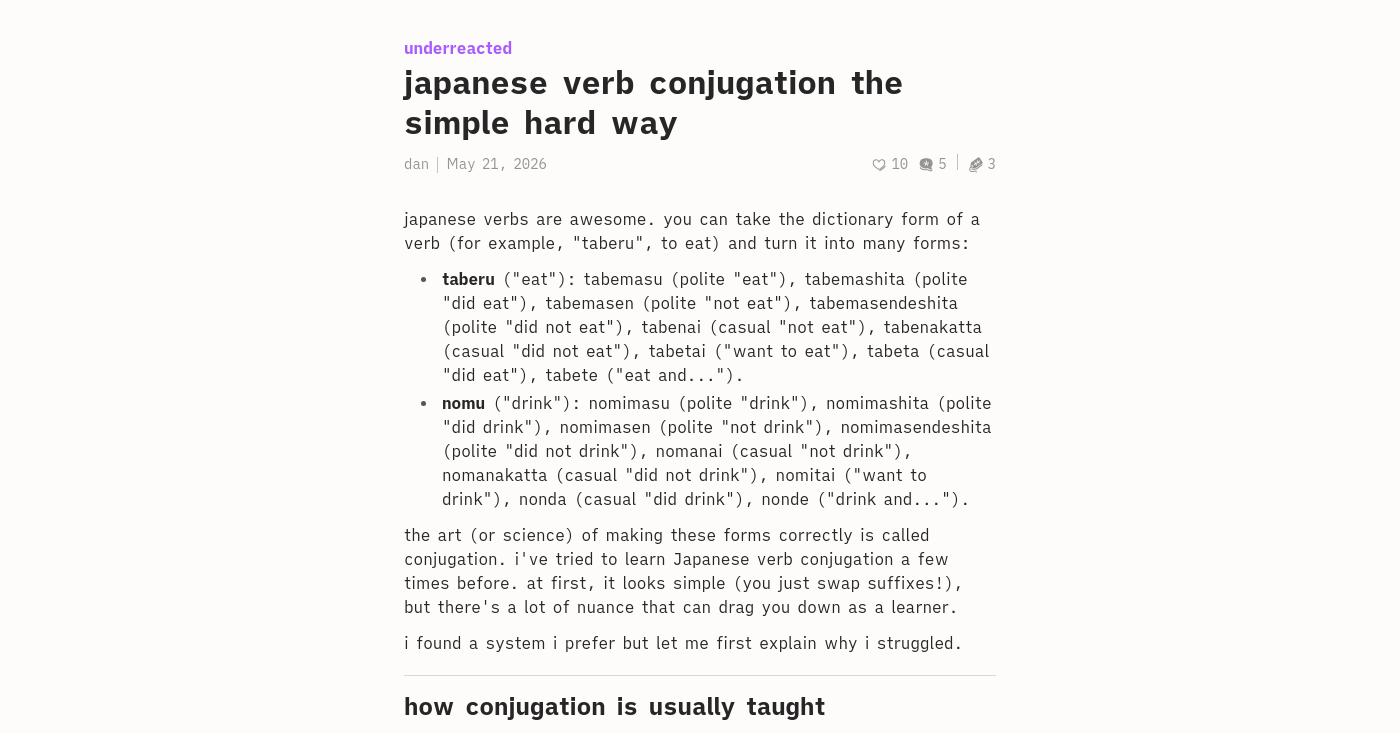
Japanese Verb Conjugation: A Comprehensive Guide to Transforming Dictionary Forms
A detailed guide to Japanese verb conjugation, explaining the patterns and rules for transforming dictionary-form verbs into various forms i
 underreacted.leaflet.pub·16d ago
Decoding the British 'sorry': A cultural reflex beyond apology
This article explores the uniquely British use of the word "sorry" as a cultural reflex rather than a literal apology. It examines how Brito
 BBC·2mo ago
Comments
Sign in to join the conversation.
No comments yet. Be the first.