
























How Frontend State Management Becomes a Distributed Monolith as Apps Scale
Your Frontend State Management Is Becoming a Distributed Monolith When state exists everywhere, ownership disappears and the application becomes impossible to reason about. State management problems …
Read the full articleYou might also wanna read
Frontend State Management Explained: Data Flow, Scalability, and Best Practices
Frontend state management is very crucial to be learnt, as every frontend application, eventually runs into the same problem, where data nee


From Microservices to Monolith: How One Company Simplified Their Architecture
After years of scaling microservices, a shift back to a monolithic architecture brought greater efficiency, reliability, and a smoother deve
 twilio.com·7mo ago
The Paradigm Shift in Front-End Rendering: From State-Based to Signal-Based Approaches
Exploring the paradigm shift from 'render where you create state' to 'render where you use state'.
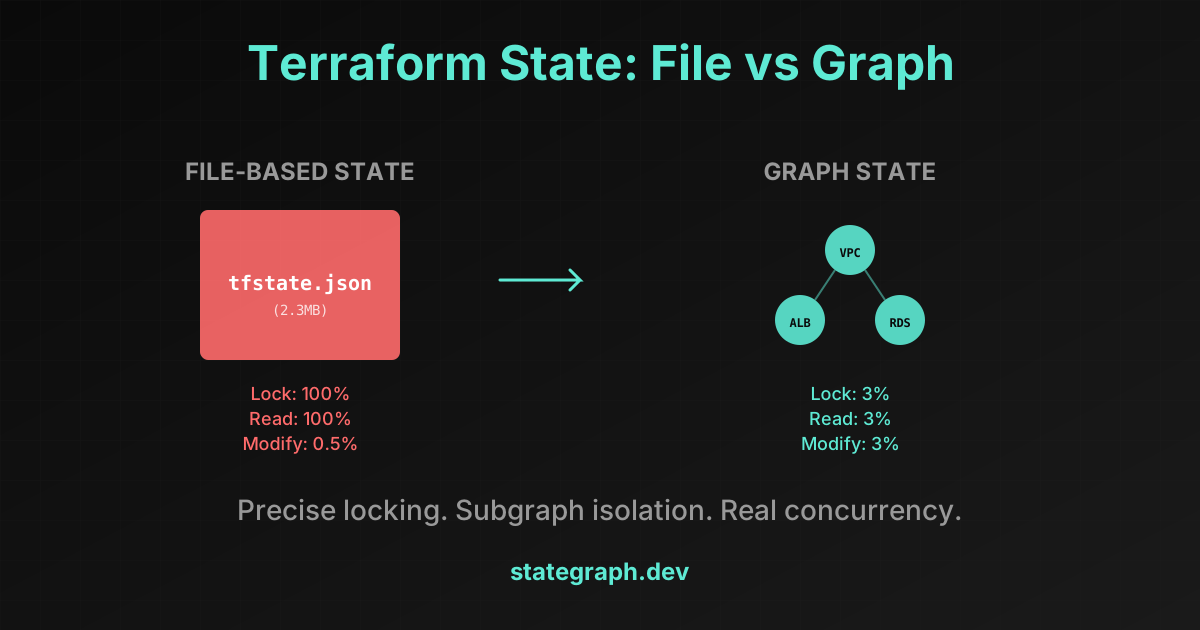
Addressing Terraform's State Management as a Distributed Systems Problem
Terraform state is fundamentally a distributed systems problem. Stategraph addresses the architectural mismatch between state representation
 stategraph.dev·10mo ago
How Decentralized Architectures Help Scale Web Apps for a Global User Base
As web applications grow to serve users across multiple continents, a single-region database becomes a performance bottleneck due to network

How LLMs and AI agents are breaking the 20-year-old stateless compute architecture
Web architecture is built on a 20-year-old assumption that state lives in the database, and compute is stateless. But we're missing a routin
 zknill.io·2mo ago
Comments
Sign in to join the conversation.
No comments yet. Be the first.