
























Understanding Weak Localization: Electron-Specific Wave Interference in Disordered Media
Summary
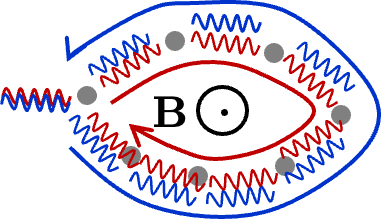
This article explains the concept of weak localization, a phenomenon specific to electrons (or charged wavepackets) in disordered media. It builds on a previous discussion about general wave localization, but narrows the focus to electronic systems in the weak scattering limit. The author explores how particular sets of trajectories and interference effects lead to localization in electronic systems, distinguishing it from the more general wave localization phenomena that apply to light, sound, and other wave types.
Source
 bskyUnderstanding Weak Localization: Electron-Specific Wave Interference in Disordered Mediananoscale.blogspot.com
Key quotes
· 3 pulledNow I want to write about a phenomenon that is specific to electrons (or at least wavepackets that carry electronic charge, if we want to be very general).
Rather than the completely general arguments about conductivity scaling, now we are going to consider particular sets of trajectories in the weak scattering limit.
We can define 'weak' scattering here in...
You might also wanna read


Nature research paper: Visualizing the impact of quenched disorder on 2D electron Wigner solids

Nanocrystal Light Emission Reveals Quantum Zero-Point Motion in Atomic Lattice
Researchers have observed unexpected light emission from a nanocrystal cooled to near absolute zero, which is shown to arise from quantum fl
 physics.aps.org·7mo ago
Exploring Quantum Brain Dynamics: Super-Radiance with Light and Sound Waves in Microtubules
The article discusses the derivation of super-radiance solutions involving coherent light and sound waves within the environment of a microt
researchgate.net·11mo ago
Mathematicians Use Network Theory to Advance Understanding of Fourier Transform
Mathematicians have made significant progress on a long-standing problem related to the Fourier transform, a fundamental mathematical tool u
 quantamagazine.org·4mo ago
Metamaterials, AI, and the Road to Invisibility Cloaks
Tiny-diffusion: A minimal implementation of probabilistic diffusion models
Comments
Sign in to join the conversation.
No comments yet. Be the first.