
























Five Years After "Stochastic Parrots": Revisiting the Landmark AI Critique in the Age of ChatGPT
By
Gwendolyn Rak
Summary
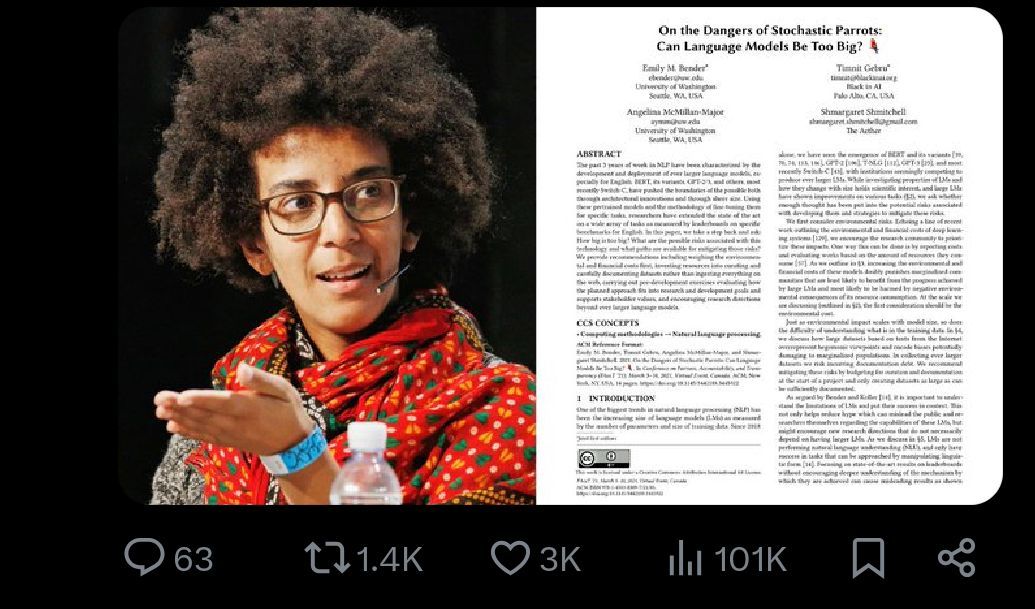
Five years after the landmark "Stochastic Parrots" paper was published, its lead author revisits the influential work in the age of ChatGPT. The original 2021 paper by Emily Bender, Timnit Gebru, Margaret Mitchell, and Angel McMillan-Major argued that large language models are fundamentally statistical text generators that mimic human language without understanding meaning—a concept captured by the "stochastic parrot" metaphor. The paper also raised concerns about the environmental costs, biases, and risks of scaling these models. The article explores how the paper's warnings have proven prescient as LLMs like ChatGPT have become mainstream, and examines the ongoing debates about AI understanding, the controversy surrounding the authors' firing from Google, and the lasting impact of their critique on AI discourse.
Source

 bskyFive Years After "Stochastic Parrots": Revisiting the Landmark AI Critique in the Age of ChatGPTspectrum.ieee.org
Key quotes
· 3 pulledLarge language models generate text by statistically predicting likely sequences of words rather than understanding what they are saying—a process the authors captured with the metaphor of a 'stochastic parrot.'
The paper received significant attention at the time (in part because Google fired two of the authors, Timnit Gebru and Margaret Mitchell, shortly before its publication).
It argued that large language models... repeat patterns from their training data without true comprehension.
You might also wanna read

Timnit Gebru's Firing and the Fulfilled Warnings of the "Stochastic Parrots" Paper on AI Risks
This article discusses Timnit Gebru's firing from Google in December 2020 after refusing to retract her research paper "On the Dangers of St
 tumblr.com·1mo ago
AI Evolution in 2025: From Stochastic Parrots to Chain of Thought Reasoning
The article reflects on the evolution of AI understanding by the end of 2025, noting that the 'stochastic parrots' criticism of LLMs has lar
antirez.com·6mo ago
The Rhetorical Battle Over LLMs: Between "Solved" and "Stochastic Parrot"
The article examines the cultural and rhetorical battle between AI maximalists who celebrate LLMs as having "solved" or "cooked" various hum
pop.rdi.sh·1mo agoThe Rhetorical Battle Over LLMs: Between "Solved" and "Stochastic Parrot"
The article examines the cultural and rhetorical battle between AI maximalists who celebrate LLMs as having "solved" or "cooked" various hum
pop.rdi.sh·1mo ago
The Erosion of Unique Human Voices in the Age of AI-Generated Content
The article argues that the widespread use of Large Language Models (LLMs) for content creation is eroding our unique human voices. The auth
 tonyalicea.dev·7mo ago
The Impact of Generative AI on the Future of the Web
The article discusses the potential long-term effects of generative models like ChatGPT on the information economy, arguing that the ability

The Problem with Sycophantic Language in Human-Chatbot Conversations
The article discusses a concerning phenomenon where users adopt sycophantic, overly deferential language when interacting with AI chatbots,
 Defector·2mo ago
Comments
Sign in to join the conversation.
No comments yet. Be the first.