
























Understanding Partial Inlining: How Compilers Optimize Functions with Fast and Slow Paths
Inlining doesn't have to be all-or-nothing
Read the full articleYou might also wanna read

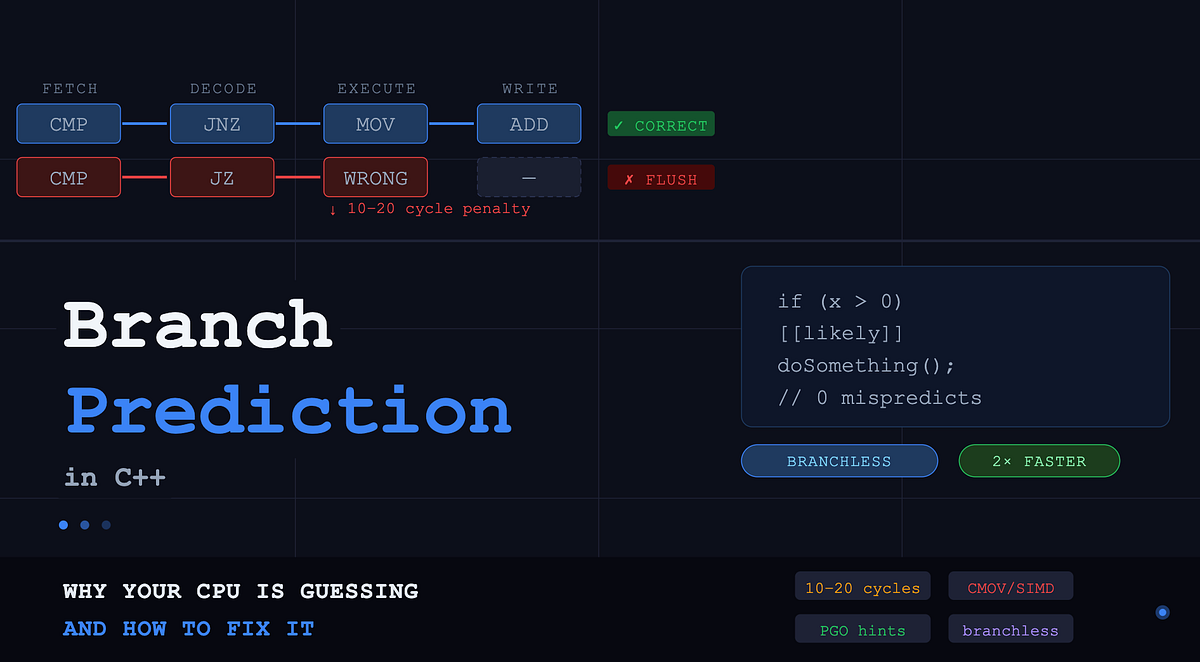
Understanding CPU Branch Prediction and Branchless Programming in C++
Stop letting CPU mispredictions slow down your code. This guide covers C++ branch prediction internals, branchless programming patterns, and
 towardsdev.com·24d ago
Silent foe or quiet ally: Brief guide to alignment in C++. Part 3 -- Elizaveta Zhegalova
We continue our deep dive into memory mechanics. If you are just joining us, I recommend reviewing the foundations first. The first part cov
CppCast·23d ago
How Pattern Recognition Transforms Slow Code into Efficient Solutions
A software developer on DEV Community illustrates how recognizing algorithmic patterns can dramatically improve coding performance. Using th
ShortSingh·1d ago

Building Faster Parsers Through Data-Oriented Design: Flat Arrays Over Pointer Trees
How designing the data structure first (flat arrays of indices instead of a pointer tree) makes a parser fast and collapses memory layout, a
arshad.fyi·19d ago
"C++23 - The Complete Guide" draft ebook is out -- Nicolai Josuttis
I am happy to announce that my new book in the " The Complete Guide " series is out now as a draft ebook C++23 - The Complete Guide by Nicol
CppCast·23d ago
Comments
Sign in to join the conversation.
No comments yet. Be the first.