

























Harvard Researchers Develop 3D-Printed Elastomer Filaments That Mimic Muscle Movement
By
May 19, 2026
Summary
Researchers at Harvard University have developed a rotational multimaterial 3D printing method that creates soft, elastomer-based filaments capable of bending, twisting, expanding, or contracting in response to temperature changes. These nature-inspired, shape-morphing fibers could one day enable artificial muscles. The research involved advanced X-ray scattering measurements at Brookhaven National Laboratory to characterize the materials' behavior.
Source

 bskyHarvard Researchers Develop 3D-Printed Elastomer Filaments That Mimic Muscle Movementbnl.gov
Key quotes
· 3 pulledRotational multimaterial 3D printing enables nature-inspired, shape-morphing filaments
These soft, elastomer-based materials could one day enable tempe
Researchers performed transmission wide-angle X-ray scattering measurements at the Soft Matter Interfaces (SMI) beamline at the National Synchrotron Light Source II
You might also wanna read

UBCO Researchers Develop 3D-Printed Living Lung Tissue
UBCO researchers have developed a 3D bio-printed model that mimics natural lung tissue, revolutionizing the study of lung disease and treatm
news.ok.ubc.ca·11mo agoGeometry and Physics of Wrinkling [pdf]


MIT Students Develop AI-Powered 3D Printer That Converts Food Waste into Household Objects
MIT students have developed a prototype 3D printer called FOODres.AI that uses artificial intelligence to transform food waste (fruit peels,
 Dezeen·9mo ago
Innovative 3D-Printed Tennis Balls Offer Eco-Friendly Alternative
Central Saint Martins graduate Noé Chouraqui has developed Point, a 3D-printed alternative to traditional tennis balls made from a bio-based
Dezeen·10mo ago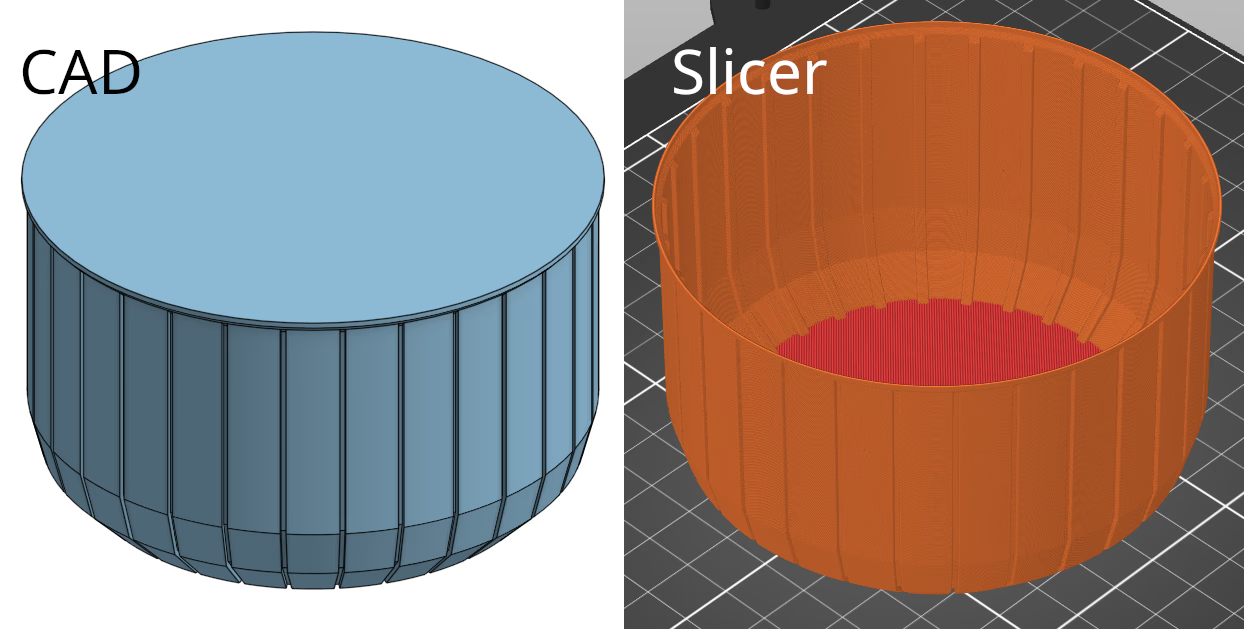
Advanced Applications of 3D Printing Vase Mode: Beyond Decorative Objects
This technical article explores advanced applications of 3D printing's vase mode beyond its conventional uses. The author compiles scattered
 vorpal.se·7mo ago
Multistable thin-shell metastructures for multiresponsive metabots
Comments
Sign in to join the conversation.
No comments yet. Be the first.