
























Understanding CPU Branch Prediction and Branchless Programming in C++
By
Sagar
Summary
This article explains CPU branch prediction in the context of C++ performance optimization. It covers how modern CPUs use pipelining to execute instructions, how branch mispredictions cause pipeline stalls, and introduces branchless programming techniques to avoid conditional branches. The piece includes benchmarking approaches to measure branch overhead and practical patterns for writing low-latency, high-performance C++ code.
Source
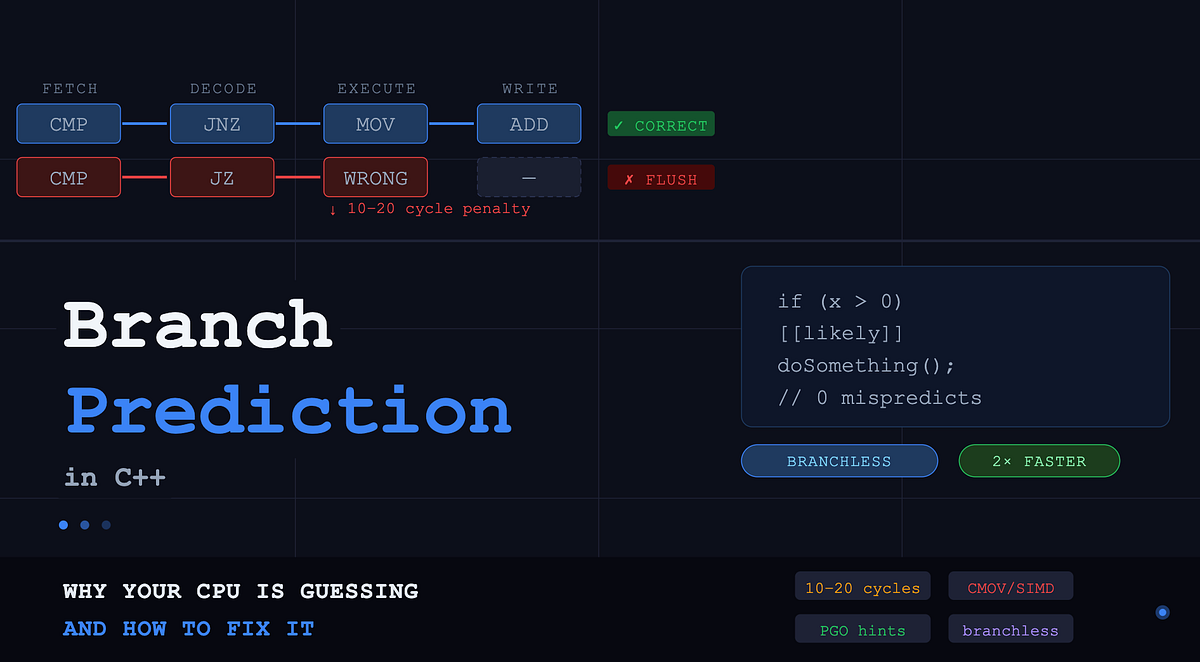
 Twitter / XUnderstanding CPU Branch Prediction and Branchless Programming in C++towardsdev.com
Key quotes
· 3 pulledModern CPUs don't execute one instruction, wait, then execute the next. They work like an assembly line.
This is called pipelining, and it's why your CPU can do billions of operations per second.
Stop letting CPU mispredictions slow down your code.
You might also wanna read

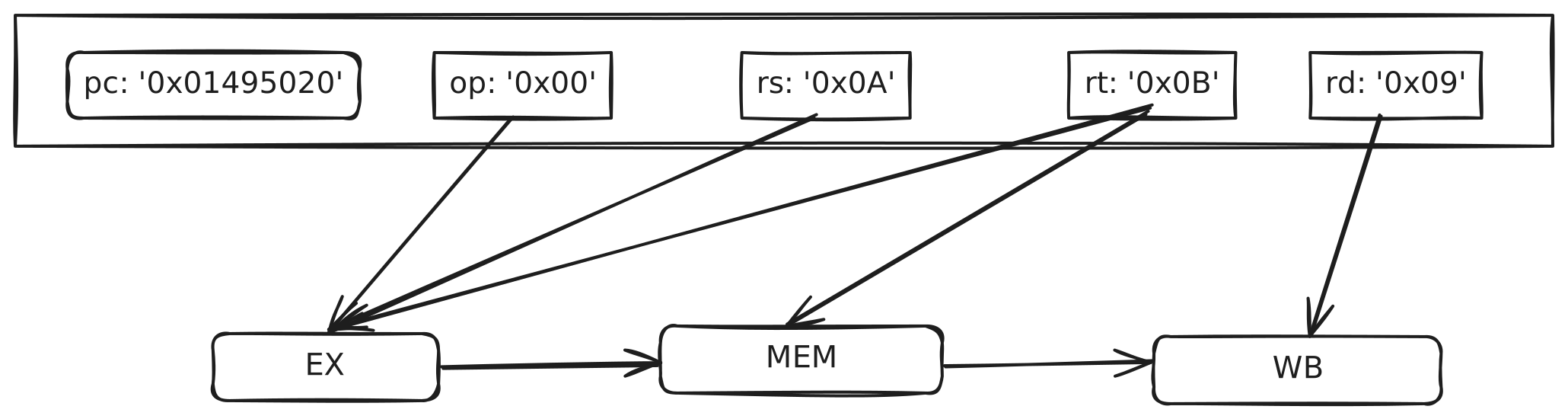
Understanding CPU Pipelining and Its Evolution into Branch Prediction
This article explores CPU pipelining concepts as part of a branch prediction series, explaining how modern processors optimize instruction e
Understanding CPU Branch Prediction and Its Impact on Benchmarking
The article discusses how modern processors use branch prediction to execute multiple instructions per cycle, explaining that CPUs have rema
 lemire.me·3mo ago
Understanding the ITTAGE Indirect Branch Predictor on Modern CPUs
The article discusses the ITTAGE indirect branch predictor and its effectiveness in predicting indirect branches inside interpreter loops on
blog.nelhage.com·11mo ago
Understanding Dataflow Graphs for C++ Performance Analysis
This article provides a comprehensive introduction to dataflow graphs as a tool for understanding and optimizing C++ code performance. The a
 fgiesen.wordpress.com·8mo ago
Optimizing Code Performance When Branch Prediction Works Against You
The article discusses techniques for optimizing program performance when branch prediction works against the code, using a financial/trading
nicula.xyz·7mo ago
The Evolution of Performance Optimization: From CPU Instructions to Data Structure Design
The article discusses how performance optimization has evolved from focusing on micro-level instruction optimization to data structure desig
 tedinski.com·7mo ago
Comments
Sign in to join the conversation.
No comments yet. Be the first.