

























Rethinking the Map of Consciousness: A Field of Experience, Not a Hierarchy
By
Ray
Summary
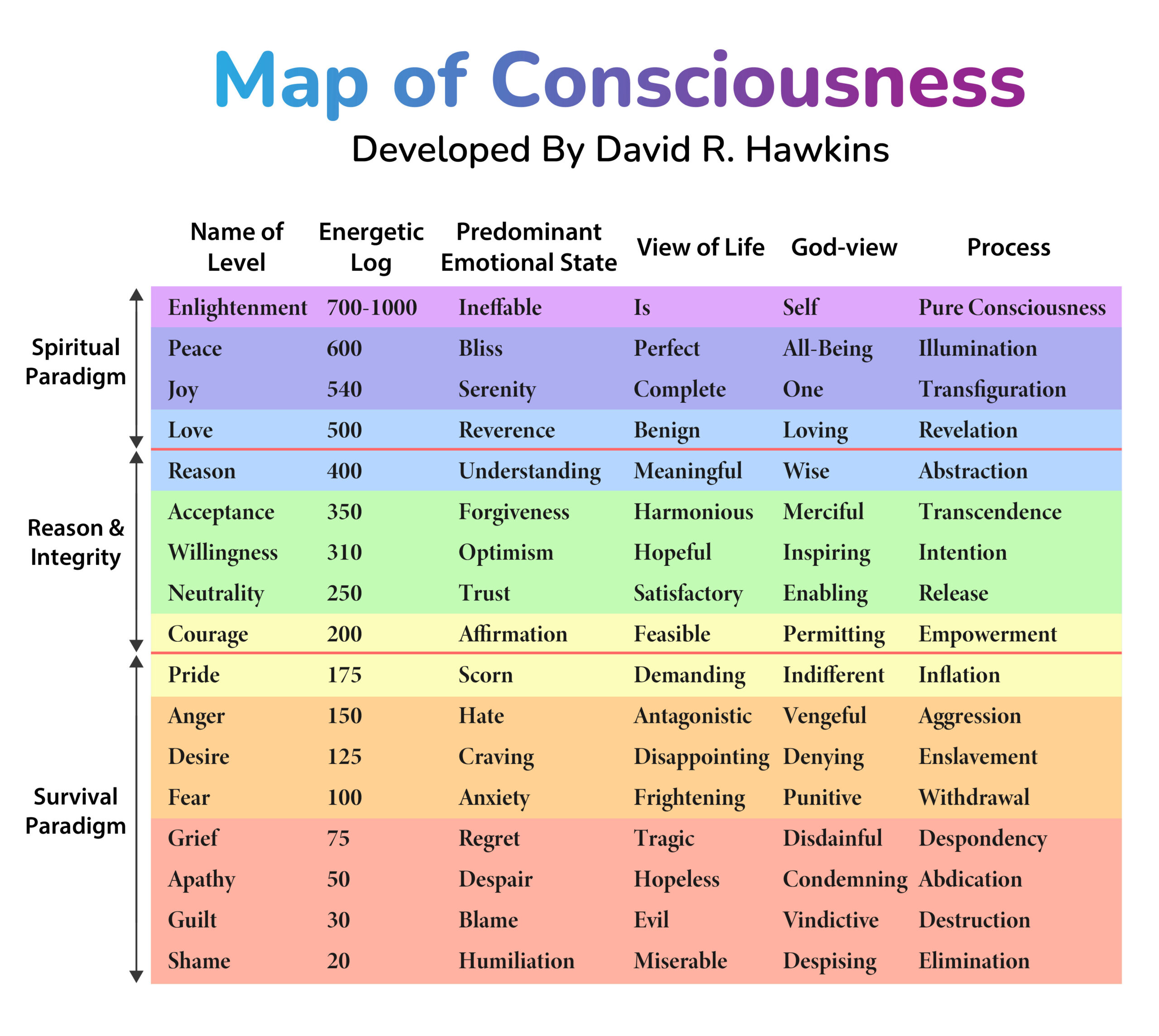
This article challenges the common interpretation of the Map of Consciousness as a hierarchical ladder where higher emotions are "better" and the goal is to climb upward. Instead, it argues that the Map describes fluid, moment-to-moment movement through different states of experience, not fixed levels of spiritual development or moral ranking. The author contends that viewing the map as a hierarchy leads to spiritual bypassing, self-judgment, and a misunderstanding of human experience as a living field rather than a static ranking system.
Source
 bskyRethinking the Map of Consciousness: A Field of Experience, Not a Hierarchydualisticunity.com
Key quotes
· 3 pulledLower is worse. Higher is better. The point is to climb.
That assumption feels so natural that it rarely gets examined. And yet it is the single biggest reason the Map of Consciousness is misunderstood.
The Map of Consciousness isn't a ladder to climb. It describes moment-to-moment movement through experience, not fixed levels or spiritual rank.
You might also wanna read


New theory proposes consciousness evolved for social benefit, not just individual survival
This article explores the evolutionary purpose of consciousness, proposing that it may have evolved primarily to benefit social connections
 universal-sci.com·2d ago
New theory proposes consciousness evolved for social benefit, not just individual survival
This article explores the evolutionary purpose of consciousness, proposing that it may have evolved primarily to benefit social connections
universal-sci.com·2d ago
Noeticmap: AI Platform Aggregating 8,000+ Documented Near-Death Experiences for Consciousness Research
Noeticmap is an AI-powered platform that aggregates and analyzes over 8,000 documented near-death experiences (NDEs) and other extraordinary
 noeticmap.com·6mo ago
Beyond the Brain: Exploring Embodied Cognition and the Three Centers of Consciousness
The article challenges the traditional neuro-centric view that locates human consciousness and identity solely in the brain. It explores the
 essays.debugyourpain.com·4mo ago
Thomas Nagel's Philosophical Exploration of Consciousness and Subjective Experience
Thomas Nagel's seminal 1974 philosophical paper explores the fundamental limitations of understanding subjective experience, particularly co
 en.wikipedia.org·9mo ago
The Consciousness Gradient: When Machines Begin to Wonder
Integrating Buddhist Phenomenology, Active Inference Theory, and Physical Reflexes: A Framework for Understanding Suffering and Cognition
This article presents a theoretical framework that unifies Buddhist phenomenology (specifically the concept of 'tanha' or craving), active i
 opentheory.net·6mo ago
Comments
Sign in to join the conversation.
No comments yet. Be the first.