
























The Granularity Paradox: When More Data Leads To Worse Forecasts
Exploring the Granularity Paradox in time-series forecasting, where finer temporal data can hinder accuracy. Is it time to reconsider our forecasting models?
Read the full articleYou might also wanna read
Information Theory and Ensemble Models
How should we ensemble time-series forecasts better? The post Information Theory and Ensemble Models appeared first on Towards Data Science

Exploring the Shift to Foundation Models in Time-Series Forecasting
Introduction In the last few years, the field of time-series forecasting has seen a fundamental shift. Where we once depended solely on clas
parseable.com·1y agoKent Osband's "Rationally Turbulent Expectations" Explores Bayesian Learning with Calm and Turbulent Phases
Kent Osband writes

Exploring Time Series Forecasting on Graph Structured Entities
Time series forecasting is a cornerstone in modern business analytics, whether it is concerned with anticipating market trends, user behavio
kumo.ai·1y ago

Recommended Practices for Data Preprocessing in AI-Driven Climate Prediction
Abstract Artificial intelligence (AI)—and specifically machine learning (ML)—applications for climate prediction across time scales are prol
 journals.ametsoc.org·24d ago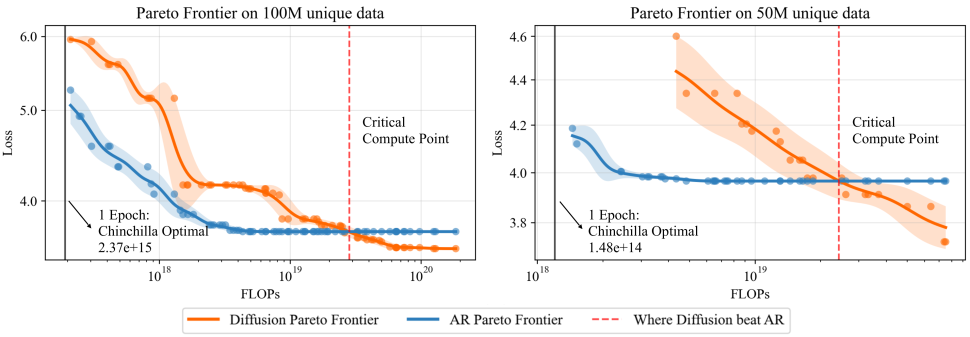
Research Shows Diffusion Models Outperform Autoregressive Models in Data-Constrained AI Settings
Check out our new blog post on "Diffusion beats Autoregressive in Data-Constrained settings". The era of infinite internet data is ending. T
 blog.ml.cmu.edu·9mo ago
Comments
Sign in to join the conversation.
No comments yet. Be the first.