
























The Cosmic Wake of the Lighthouse Pulsar
The Cosmic Wake of the Lighthouse Pulsar Lighthouse Pulsar (PSR J1101-6101) More images and information Credit: X-ray: Chandra: NASA/CXC/Stanford Univ./J. Dinsmore et al.; IXPE: NASA/MSFC/J. Dinsmore…
Read the full articleYou might also wanna read


NASA Space Telescope Maps Magnetic Fields of ‘Lighthouse’ Pulsar
For the first time, scientists have used NASA’s IXPE (Imaging X-ray Polarimetry Explorer) to directly measure the magnetic fields of PSR J11
NASA Space Telescope Maps Magnetic Fields of ‘Lighthouse’ Pulsar
For the first time, scientists have used NASA’s IXPE (Imaging X-ray Polarimetry Explorer) to directly measure the magnetic fields of PSR J11
NASA Space Telescope Maps Magnetic Fields of ‘Lighthouse’ Pulsar
For the first time, scientists have used NASA’s IXPE (Imaging X-ray Polarimetry Explorer) to directly measure the magnetic fields of PSR J11
Quasar at the Dawn of the Universe “Blinked” for Astronomers have observed the flickering quasar J0439+1634 as it appeared just 850 million years after the Big Bang — one of the earliest such objects
Quasar at the Dawn of the Universe “Blinked” for Astronomers have observed the flickering quasar J0439+1634 as it appeared just 850 million
Polarized Multiwavelength Emission from Pulsar Wind–Accretion Disk Interaction in a Transitional Millisecond Pulsar
Maria Cristina Baglio et al 2025 ApJL 987 L19 Researchers find evidence that the polarized and pulsed emission from the pulsar PSR J1023+003
The oldest map of the cosmos bears invisible wrinkles of gravity: the Sachs-Wolfe effect
The cosmic microwave background preserves traces of tiny gravitational variations—the seeds that shaped matter, primordial light, and the st

Faint radio signals detected from previously silent 'Blue Eye' neutron star for the first time
The hushed pulsar, nicknamed Blue Eye, was a previously radio-silent neutron star.
 Space·3d ago
Faint radio signals detected from previously silent 'Blue Eye' neutron star for the first time
The hushed pulsar, nicknamed Blue Eye, was a previously radio-silent neutron star.
space.com·3d agoFaint radio signals detected from previously silent 'Blue Eye' neutron star for the first time
The hushed pulsar, nicknamed Blue Eye, was a previously radio-silent neutron star.
space.com·3d ago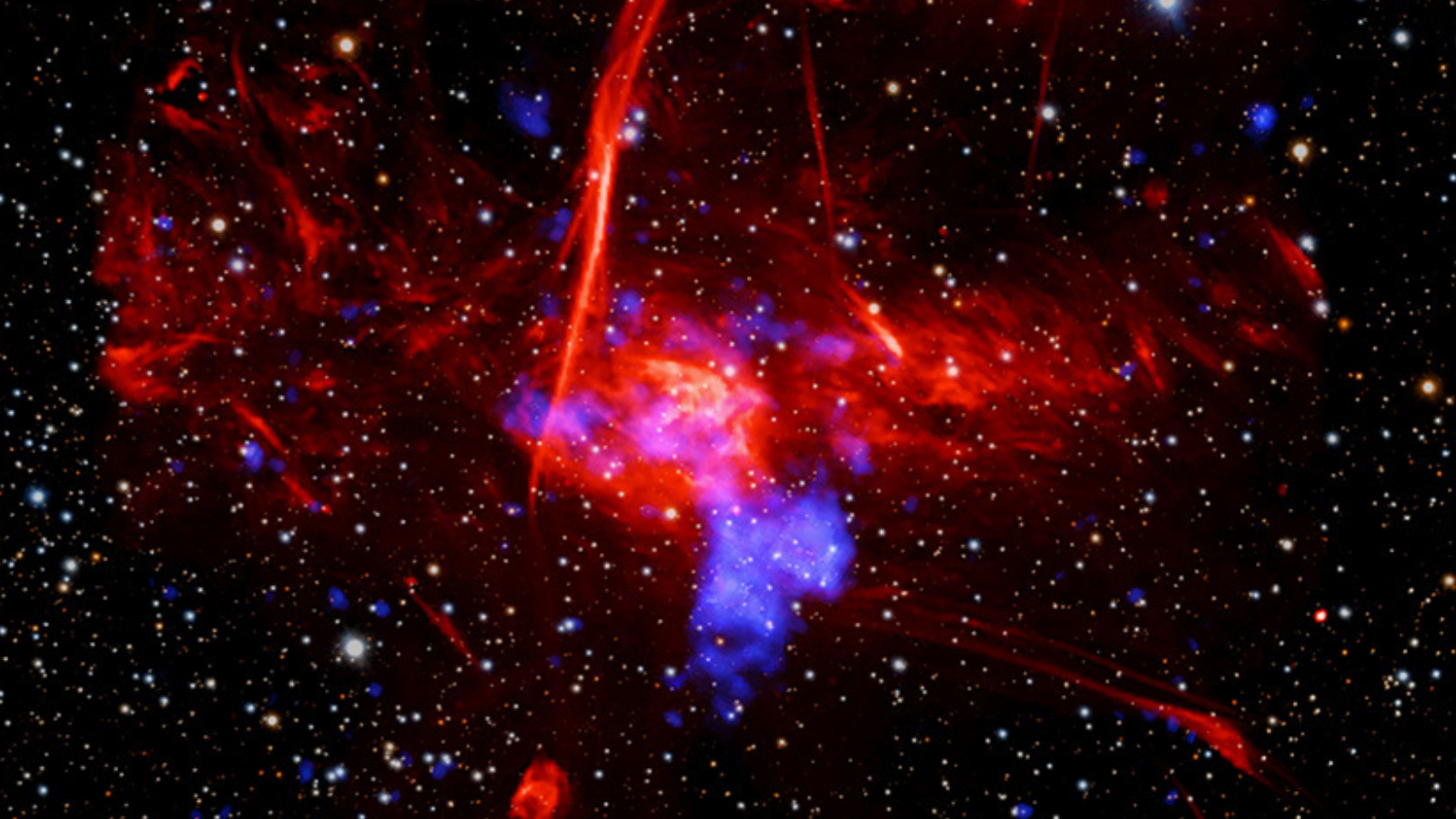
NASA's Chandra X-ray Observatory detects supernova debris near Milky Way's supermassive black hole
The dead star erupted around 1,700 years ago. It ejected material at around 2 million miles per hour.
 space.com·24d ago
Comments
Sign in to join the conversation.
No comments yet. Be the first.