
























A Technical Taxonomy of LLM Agent Communication Protocols: Classifying Multi-Agent System Interoperability
By
[Submitted on 17 Jun 2026]
Summary
This study develops a technical taxonomy to classify and analyze LLM agent communication protocols. Using an established iterative method, the researchers analyzed nine actively maintained open-source protocols across five dimensions: counterparty, payload, interaction state, discovery mechanism, and schema flexibility. Key findings include that all sampled agent-to-agent protocols combine hybrid payloads with session-state persistence, most support multiple predefined schemas, and two negotiate schemas at runtime—indicating a trend toward schema flexibility. Decentralized discovery remains rare. The analysis suggests short-term convergence pressure toward unified protocols, but long-term evolution toward a federated, layered protocol stack rather than a single dominant protocol. The framework guides protocol selection and highlights open research gaps such as privacy and policy enforcement.
Source

 Twitter / XA Technical Taxonomy of LLM Agent Communication Protocols: Classifying Multi-Agent System Interoperabilityarxiv.org
Key quotes
· 5 pulledAs large language models (LLMs) advance and multi-agent systems aim to overcome the limits of standalone agents, robust communication protocols are becoming essential infrastructure for distributed agent networks.
Nonetheless, the fragmented protocol landscape presents a significant interoperability challenge.
Classification reveals recurring architectural patterns: all sampled agent-to-agent protocols combine hybrid payloads with session-state persistence.
Analysis suggests short-term convergence pressure toward protocols unifying agent-to-agent and agent-to-context (tool and data) communication.
Long-term, however, no single protocol is likely to maximize versatility, efficiency, and portability simultaneously. The field will more likely evolve toward a federated, layered protocol stack.
You might also wanna read
Agora: Toward Autonomous Bug Detection in Production-Level Consensus Protocols with LLM Agents


Advancing Agent Architectures: Beyond Shallow LLM Implementations
The article discusses the limitations of simple agent architectures using LLMs (Large Language Models) and introduces solutions like plannin
 blog.langchain.com·10mo ago
Redesigning Data Systems for LLM Agent Workloads: Addressing Agentic Speculation Challenges
This research paper argues that data systems need to be redesigned to better support LLM agents, which are predicted to become the dominant
arxiv.org·9mo ago
The Evolution of LLM Customization: From Simple Prompts to Complex Agent Systems
The article examines the evolution of LLM (Large Language Model) customization and extension mechanisms over the past three years, tracing t
 sawyerhood.com·7mo ago
Applying Distributed Systems Theory to Large Language Model Teams
The article proposes using distributed systems theory as a principled framework for creating and evaluating teams of large language models (
arxiv.org·15d agoApplying Distributed Systems Theory to Large Language Model Teams
The article proposes using distributed systems theory as a principled framework for creating and evaluating teams of large language models (
arxiv.org·15d ago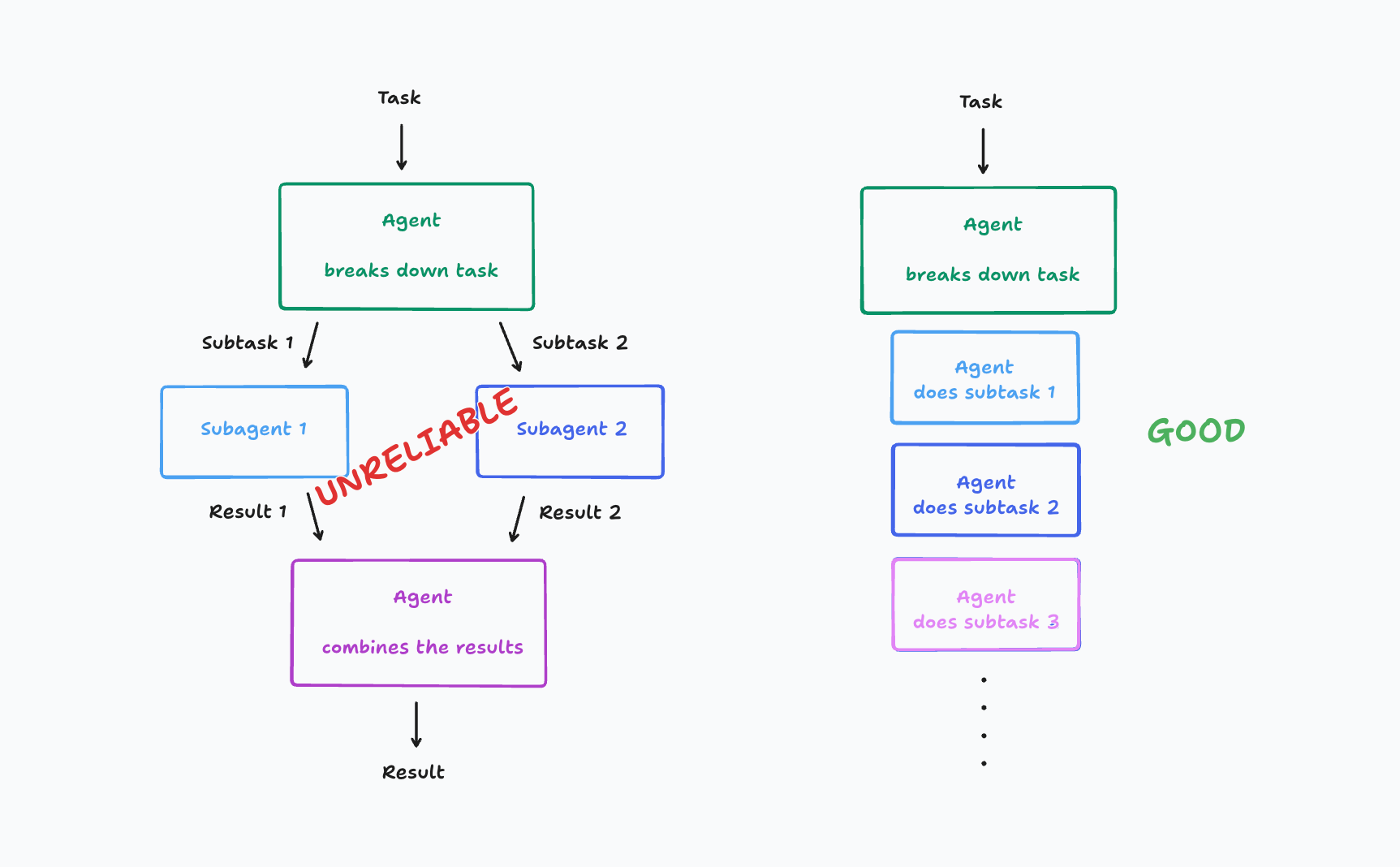
Principles for Effective LLM Agent Development: Avoiding Multi-Agent Pitfalls
The article critiques current LLM agent frameworks and proposes principles for building effective agents based on the author's practical exp
 cognition.ai·9mo ago
Comments
Sign in to join the conversation.
No comments yet. Be the first.