
























Roman telescope will spot distant black holes that shred stars
How do black holes at the centers of galaxies form and grow over time? To answer this question, scientists need to detect and study supermassive black holes at great distances that existed much…
Read the full articleYou might also wanna read


NASA’s Roman Telescope Will Spot Distant Black Holes That Shred Stars
Lee esta nota de prensa en español aquí. How do black holes at the center of galaxies form and grow over time? To answer this question, scie

NASA Sets Roman Space Telescope Launch for No Earlier Than Aug. 30
It will study billions of galaxies, dark energy, and exoplanets. On Wednesday, the National Aeronautics and Space Administration (NASA) anno
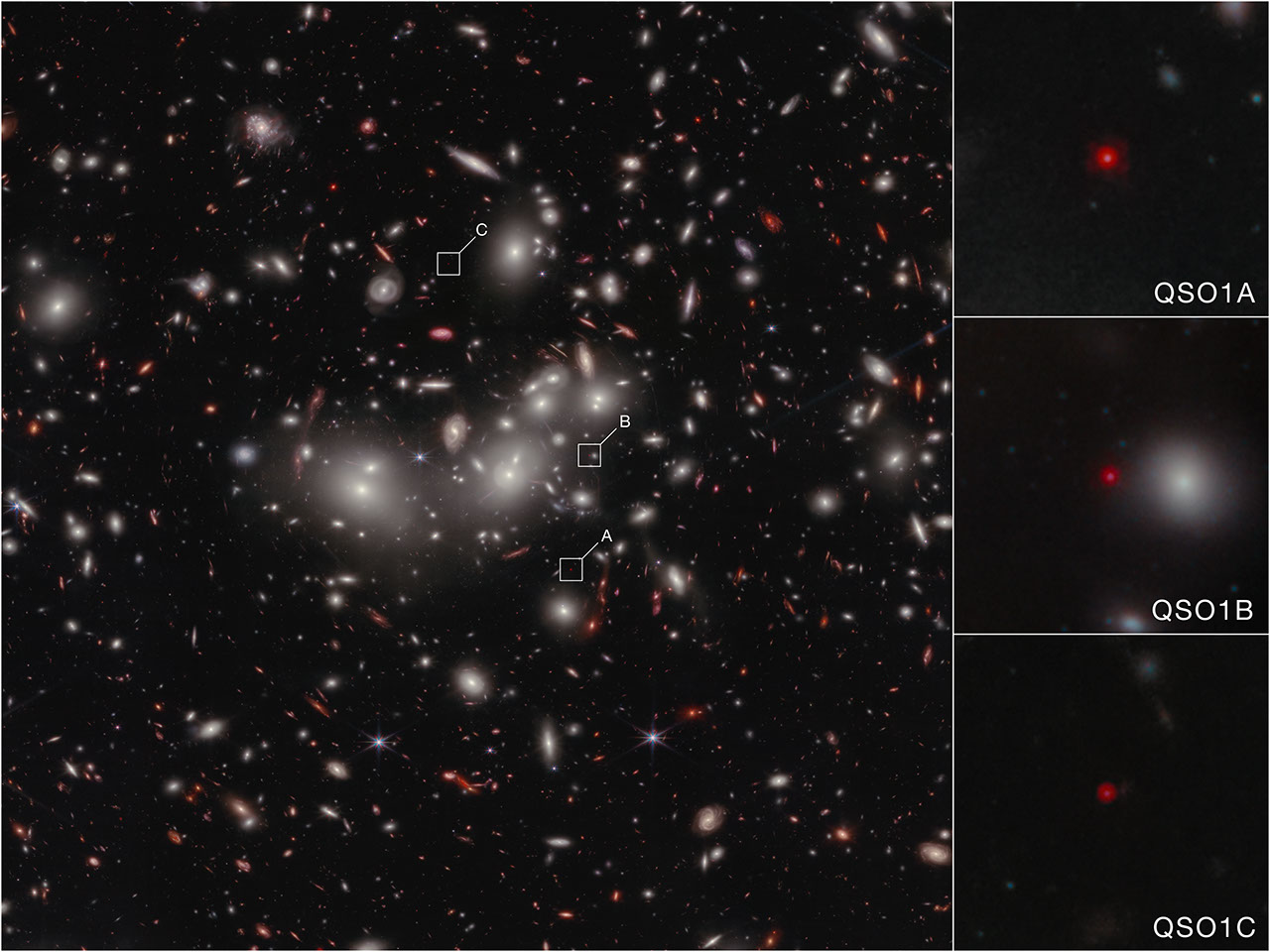
NASA's Webb Telescope Detects Black Hole That Formed Before Its Host Galaxy, Challenging Cosmic Evolution Theories
Which comes first, the galaxy or the black hole? We don’t know, but scientists have long thought it could be the galaxy: Large stars within
 science.nasa.gov·1mo ago
A quasar breaks the record for most distant supermassive black hole
The Euclid space telescope discovery could help researchers understand how black holes grew so massive so quickly in the early universe.

Euclid telescope discovers oldest known quasar, shining with light of a trillion suns from 670 million years after the Big Bang
"These early quasars date back to the universe's infancy."
 space.com·7d ago
Euclid telescope discovers oldest known quasar, shining with light of a trillion suns from 670 million years after the Big Bang
"These early quasars date back to the universe's infancy."
Space·7d agoEuclid telescope discovers oldest known quasar, shining with light of a trillion suns from 670 million years after the Big Bang
"These early quasars date back to the universe's infancy."
Space·7d agoEuclid telescope discovers oldest known quasar, shining with light of a trillion suns from 670 million years after the Big Bang
"These early quasars date back to the universe's infancy."
space.com·7d ago
NASA’s Nancy Grace Roman Space Telescope, launching in 2026, is expected to find around 100,000 planets beyond our solar system in a single mission — after nearly 30 years of searching, astronomers have confirmed roughly 6,000.
NASA already flies two famous space telescopes, Hubble and James Webb. A third is almost ready: the Nancy Grace Roman Space Telescope, launc
Comments
Sign in to join the conversation.
No comments yet. Be the first.