

























Binghamton University researchers develop Wordle strategy with 99% success rate using information theory
Summary
Researchers at Binghamton University have developed a mathematical Wordle-solving strategy that achieves a 99% success rate. The approach uses Shannon entropy and information theory principles to maximize information gain from each guess, rather than simply guessing likely words. By focusing on guesses that slash uncertainty and narrow possibilities faster, the method significantly outperforms traditional Wordle tactics.
Source
 bskyBinghamton University researchers develop Wordle strategy with 99% success rate using information theorysciencedaily.com
Key quotes
· 3 pulledResearchers at Binghamton University, State University of New York, say they have developed a mathematical approach that can solve Wordle with a remarkable 99% success rate.
The method uses Shannon entropy to identify guesses that reveal the most about the hidden word.
Each guess is designed to slash uncertainty and narrow the possibilities faster.
You might also wanna read


The Problem with Using LLMs for Information Retrieval: Why Perfect Accuracy Isn't Enough
The article presents a critical perspective on using Large Language Models (LLMs) like GPT for information retrieval, arguing that even if t
 lr0.org·3mo ago
Twenty Rules for Formulating Knowledge to Accelerate Learning with Spaced Repetition
Dr. Piotr Wozniak's article presents twenty rules for formulating knowledge to optimize learning through spaced repetition. The core premise
 supermemo.com·9mo ago
GPT-5's search capabilities prove surprisingly effective, changing the chatbot-as-search-engine calculus
The article discusses how GPT-5 (nicknamed "Research Goblin") has become remarkably effective at using its Bing-backed search tool to answer
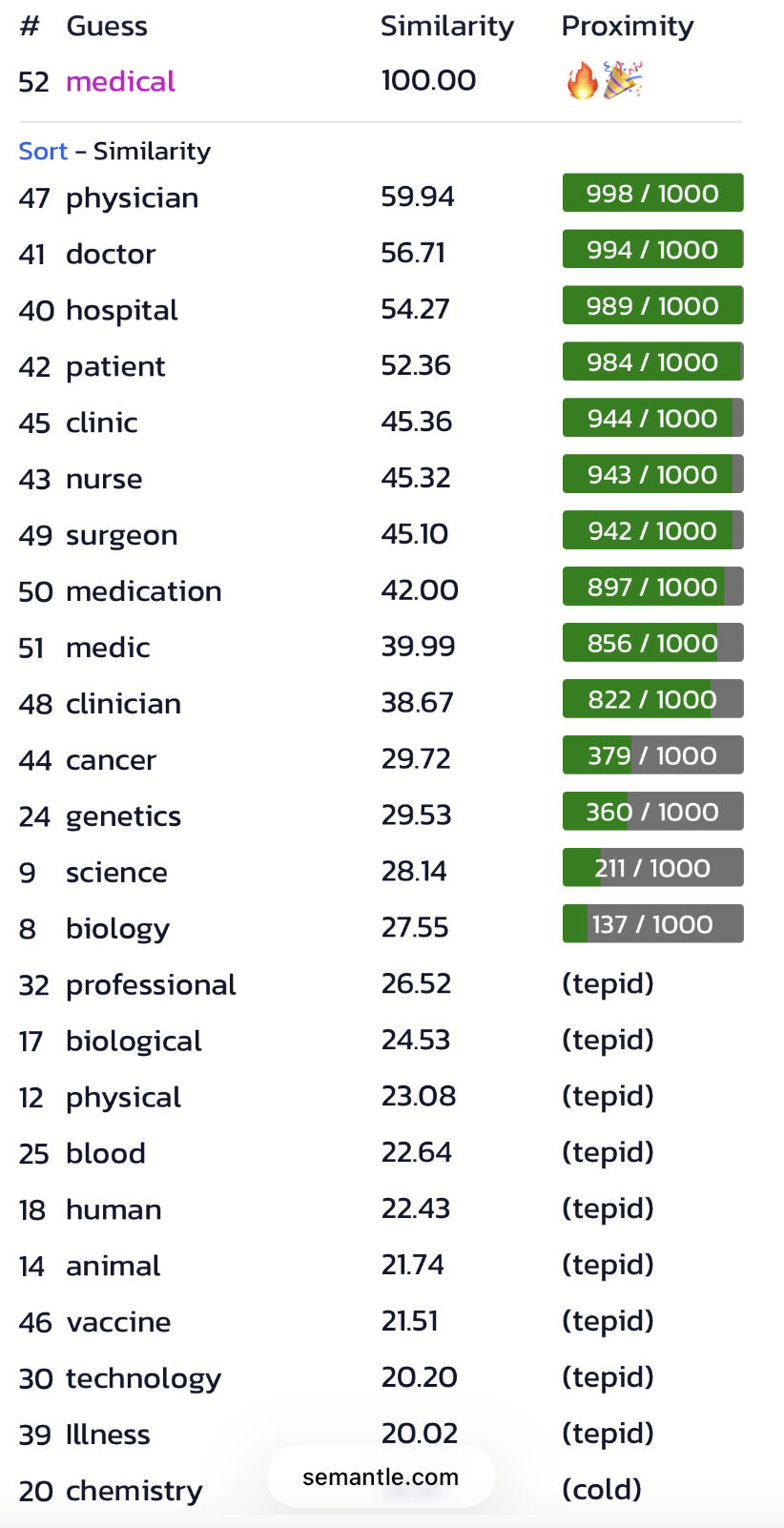
Understanding Semantle: A Wordle Variant That Uses Semantic Similarity Scoring
The article discusses Semantle, a Wordle variant that scores guesses based on semantic similarity rather than lexical similarity. The author
 victoriaritvo.com·4mo ago
Machine Learning Approach Improves Theories of Human Decision-Making
Researchers developed a novel approach using machine learning to evaluate, improve, and generate new theories of human decision-making. The
 science.org·10mo ago
Applying Rademacher Complexity and Mean Field Approximations to Evolutionary Models of Group Selection
This article explores the intersection of machine learning concepts (Rademacher Complexity and mean field approximations) with evolutionary
 symmetrybroken.com·7mo ago
Comments
Sign in to join the conversation.
No comments yet. Be the first.