
























Researchers develop predictive framework to optimize 2D perovskite solar cell efficiency
By
Shreeyashi Ojha
Summary
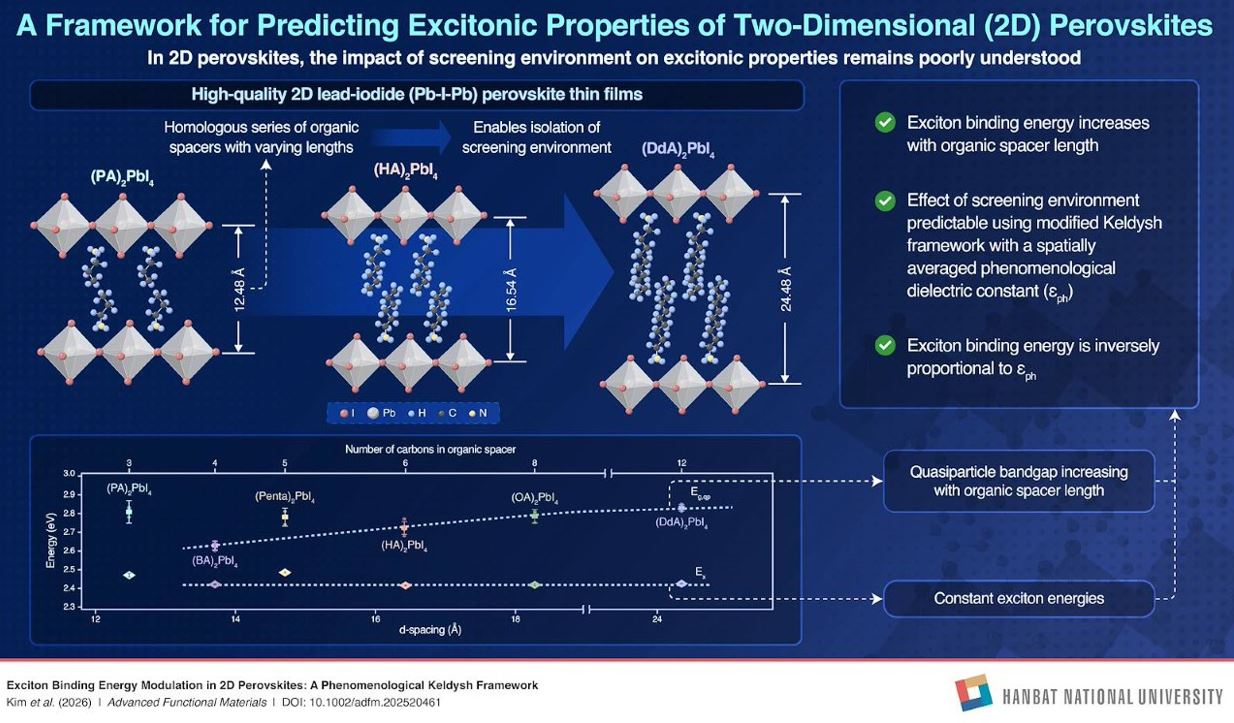
Researchers have developed a predictive framework to optimize 2D perovskite solar cell design by better understanding how excitons (electron-hole pairs) behave in these materials. The study focuses on dielectric screening — how the material's internal environment weakens the attraction between electrons and holes — which directly impacts how efficiently sunlight is converted into electricity. By isolating and understanding this mechanism, the framework aims to guide the design of more efficient and stable perovskite solar cells, addressing a key challenge in the field.
Source
 bskyResearchers develop predictive framework to optimize 2D perovskite solar cell efficiencypv-tech.org
Key quotes
· 3 pulledThe study tackles a long-standing challenge in improving 2D perovskite materials by better understanding how they absorb and transport light.
How tightly these pairs stay bound affects how efficiently solar cells can convert sunlight into electricity.
By uncovering what controls this behaviour, the researchers hope to help design more efficient and stable perovskite solar cells.
You might also wanna read


Call for Papers: Special Issue on Precision Chemistry for Halide Perovskites
This is a Call for Papers for a Special Issue focused on Precision Chemistry for Halide Perovskites. It highlights halide perovskites as a r
 go.acs.org·3d ago
Electrodeposited self-assembled molecules for perovskite photovoltaics

Isomeric multi-hydrogen-bonding enables blue perovskite LEDs

New Perovskite Betavoltaic Cell Promises Decades of Power Without Recharging
A research group at DGIST developed a perovskite betavoltaic cell using carbon-14 and perovskite materials, offering long-lasting power for
neowin.net·11mo ago
Researchers Develop Materials for Light-Based Computer Chips to Improve Efficiency and Speed
Researchers are developing light-based computers that use photons instead of electricity, which could offer greater energy efficiency and fa

Comments
Sign in to join the conversation.
No comments yet. Be the first.