
























Study finds widespread inaccessibility and spatial inequity in Atlanta's public bathroom infrastructure
By
Brandie Banner Shackelford,
Summary
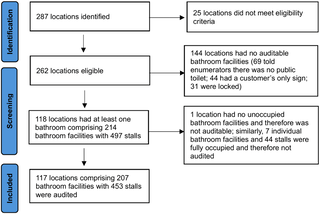
This study examines the availability, accessibility, and characteristics of public bathrooms in Atlanta, Georgia, treating them as a critical yet underexamined component of urban health infrastructure. Researchers conducted systematic audits across 15 areas, assessing 262 locations with 32 location-specific and 86 bathroom-specific criteria. Key findings reveal that 55.3% of identified locations were inaccessible, overall facility density was 18.2 per square kilometer with wide spatial variation (2.55-76.4), and 58.9% of accessible bathrooms were privately funded. Government-funded bathrooms had more functional toilets, urinals, and sinks, while privately funded facilities were more likely to be single-occupancy and accessible without gates or turnstiles. The study underscores spatial inequities and a reliance on private infrastructure to meet public sanitation needs.
Source
 bskyStudy finds widespread inaccessibility and spatial inequity in Atlanta's public bathroom infrastructurejournals.plos.org
Key quotes
· 5 pulledPublic bathrooms are a critical yet underexamined component of urban health infrastructure in the United States.
Of 262 identified locations, 55.3% were inaccessible due to lack of a publicly accessible bathroom, locked doors, or being fully occupied for more than 10 minutes.
Government-funded bathrooms had a larger quantity of functional toilets, urinals, and sinks, whereas privately funded facilities were more likely to be single-occupancy and allow use without first requiring access via gate or turnstile.
Findings reveal spatial inequities in public bathroom access across Atlanta and a reliance on private infrastructure to meet public needs, underscoring uneven urban sanitation provisions as a feature of the city's built environment.
As public bathroom availability declines, private bathrooms like those in businesses are increasingly serving as de facto 'public' options, raising questions about equity and accessibility.
You might also wanna read


The Importance of Public Toilets in Urban Design
The article emphasizes the importance of public toilets as vital infrastructure and calls for architects and designers to increase their pre
 Dezeen·1y ago
Public toilets in England decline by 14% over past decade, creating 'toilet deserts', study finds
A study by the Royal Society for Public Health reveals that the number of public toilets in England has dropped by 14% over the past decade,
Dezeen·2mo ago
The Rise of Smart Toilet Sensors: Do We Really Need an App to Track Our Bathroom Habits?
A critical look at the trend of high-tech toilet sensors like Kohler Health's Dekoda biotrackers that track bathroom habits, questioning whe
 thecut.com·6d ago
The Decline of Single-Room Occupancy Housing and Its Impact on American Homelessness
The article examines the disappearance of single-room occupancy (SRO) housing in America, tracing how the YMCA and similar institutions once
 ryanpuzycki.com·7mo ago
The Transparency Problem Behind AI Data Center Construction
The article investigates the lack of transparency surrounding AI data center construction in local communities. The author, who has a histor
 thebrockovichreport.com·1mo ago
The Transparency Problem Behind AI Data Center Construction
The article investigates the lack of transparency surrounding AI data center construction in local communities. The author, who has a histor
thebrockovichreport.com·1mo ago
Comments
Sign in to join the conversation.
No comments yet. Be the first.