
























Protosolar D-to-H Abundance and One Part per Billion PH3 in the Coldest Brown Dwarf
Melanie J. Rowland et al 2024 ApJL 977 L49 Researchers report the first measurement of the deuterium-to-hydrogen ratio in a substellar object outside the solar system; this measurement suggests a…
Read the full articleYou might also wanna read


Isotopic Evidence for a Cold and Distant Origin of the Interstellar Object 3I/ATLAS
Interstellar objects provide the only directly observable samples of icy planetesimals formed around other stars, and can therefore provide
 arxiv.org·4mo ago
JWST detects molecular hydrogen in the ultra-low metallicity dwarf galaxy Leo P
Considering that molecular hydrogen is the most abundant molecule in the universe, you’d think it’d be easier to find.
 astrobites.org·6d ago
JWST detects molecular hydrogen in the ultra-low metallicity dwarf galaxy Leo P
Considering that molecular hydrogen is the most abundant molecule in the universe, you’d think it’d be easier to find.
astrobites·6d ago
VLT Study Reveals Dramatic Nickel Emission and CN Outgassing in Interstellar Comet 3I/ATLAS
We report VLT spectroscopy of the interstellar comet 3I/ATLAS (C/2025 N1) from $r_{\rm h}\!\simeq\!4.4$ to $2.85$ au using X-shooter (300-55
arxiv.org·10mo agoAerosols and hydrocarbons in the atmosphere of a white dwarf planet
Nature, Published online: 01 July 2026; doi:10.1038/s41586-026-10514-7 Transmission spectroscopy of the planet WD 1856 b, orbiting a white d
Astronomers characterize 'improbable' system shaped by brown dwarf
In the course of studying planets beyond our solar system (6,316 confirmed exoplanets and counting), scientists have discovered some very in
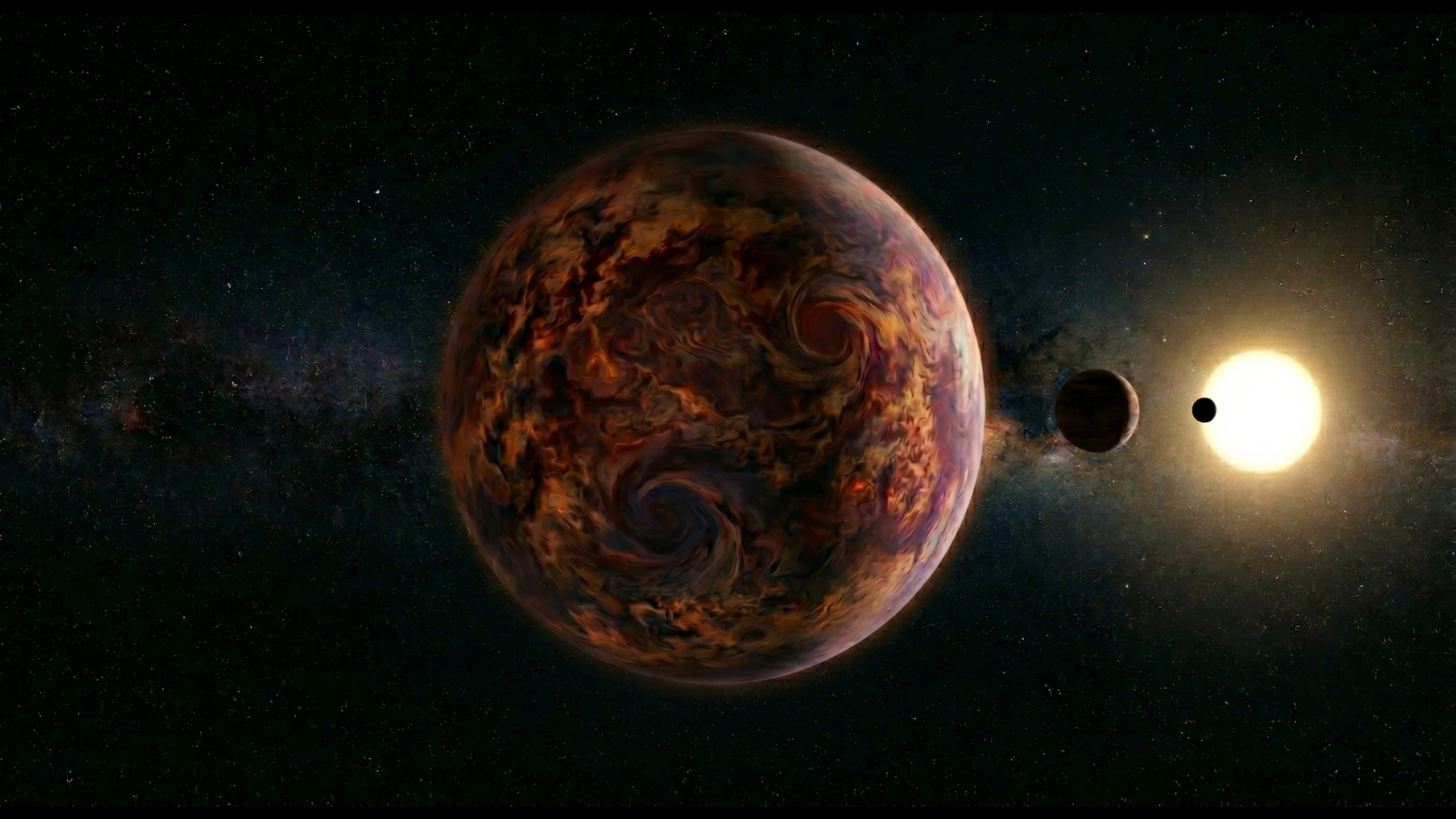
NASA's TESS discovers unusual exoplanet system shaped by a brown dwarf
"This discovery provides a crucial insight into how planets form even around massive, eccentric objects."
 space.com·16d ago
NASA's TESS discovers unusual exoplanet system shaped by a brown dwarf
"This discovery provides a crucial insight into how planets form even around massive, eccentric objects."
space.com·16d ago
Comments
Sign in to join the conversation.
No comments yet. Be the first.