
























Why Property Rights Won't Protect Our Privacy: A Critical Analysis of Personal Data Ownership
By
Daniel J. Solove
Summary
This article examines the argument that personal data should be treated as property to protect privacy. The author, who wrote about this issue over twenty years ago in his book THE DIGITAL PERSON, argues that property rights for personal data are not an effective solution for privacy protection. The piece critically analyzes why ownership models fail to adequately safeguard privacy in the information age, drawing on long-standing legal and philosophical reasoning about the nature of personal data and property rights.
Source
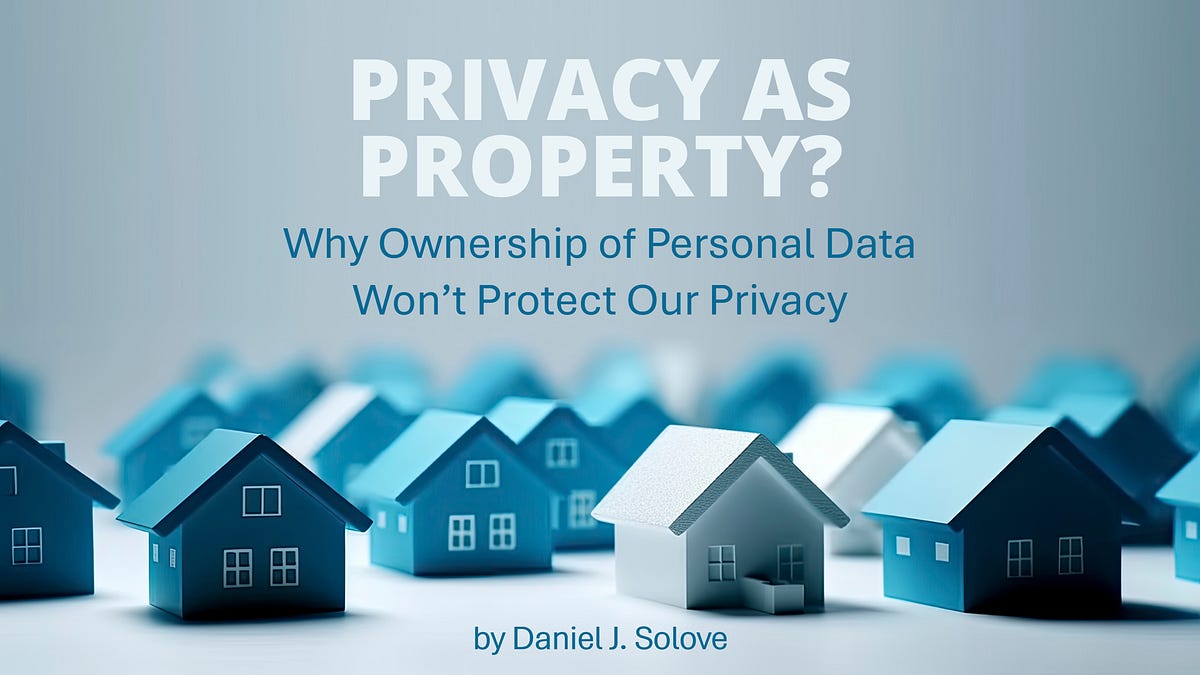
 bskyWhy Property Rights Won't Protect Our Privacy: A Critical Analysis of Personal Data Ownershipdanielsolove.substack.com
Key quotes
· 3 pulledI've often heard arguments that an effective way to protect privacy would be to protect personal data with property rights.
The thinking behind this idea is that ownership of property confers a lot of power on the owner, so perhaps this is the best way to empower individuals to control their data.
Unfortunately, it doesn't work.
You might also wanna read
Reframing Privacy as Control: Why Digital Identity Protection Matters
The article challenges the common argument "I have nothing to hide" regarding privacy concerns, arguing that privacy should be reframed as "
The Growing Threat to Personal Privacy: How Data Collection Has Escalated Beyond Public Awareness
The article discusses the severe deterioration of privacy in modern society, highlighting how extensive personal data is being collected, cr

Moving Your Digital Stack to Europe: A Practical Guide to Digital Sovereignty
The article discusses the author's personal journey of migrating their digital tools and infrastructure from US-based cloud services to Euro
 monokai.com·1mo ago
System76's Perspective on Age Verification Laws and Digital Freedom
The article discusses System76's perspective on age verification laws, using personal anecdotes about childhood curiosity and access to info
 blog.system76.com·3mo ago
Do I have a right to privacy in my garden? Here's what you can (and can't) do
 Ideal Home·1y ago
The Erosion of User Freedom in Modern Computing: From Complete Control to Locked-Down Systems
The article examines the gradual erosion of user freedom in computing, contrasting the early days of microcomputers where users had complete
 hackaday.com·8mo ago
Comments
Sign in to join the conversation.
No comments yet. Be the first.