
























How Moondream's Photon Engine Eliminates the GPU Bubble for Faster AI Inference
By
radq
Summary
Moondream's engineering team explains the "GPU bubble" phenomenon — where GPUs sit idle waiting for CPU instructions during AI model inference. The article details how their inference engine, Photon, optimizes GPU utilization to achieve near-realtime vision-language model inference (~33ms on NVIDIA B200) with up to 35% higher decode throughput. It's a deep technical dive into GPU architecture, kernel optimization, and the engineering challenges of making AI inference faster by eliminating idle GPU cycles.
Source
 Hacker NewsHow Moondream's Photon Engine Eliminates the GPU Bubble for Faster AI Inferencemoondream.ai
Key quotes
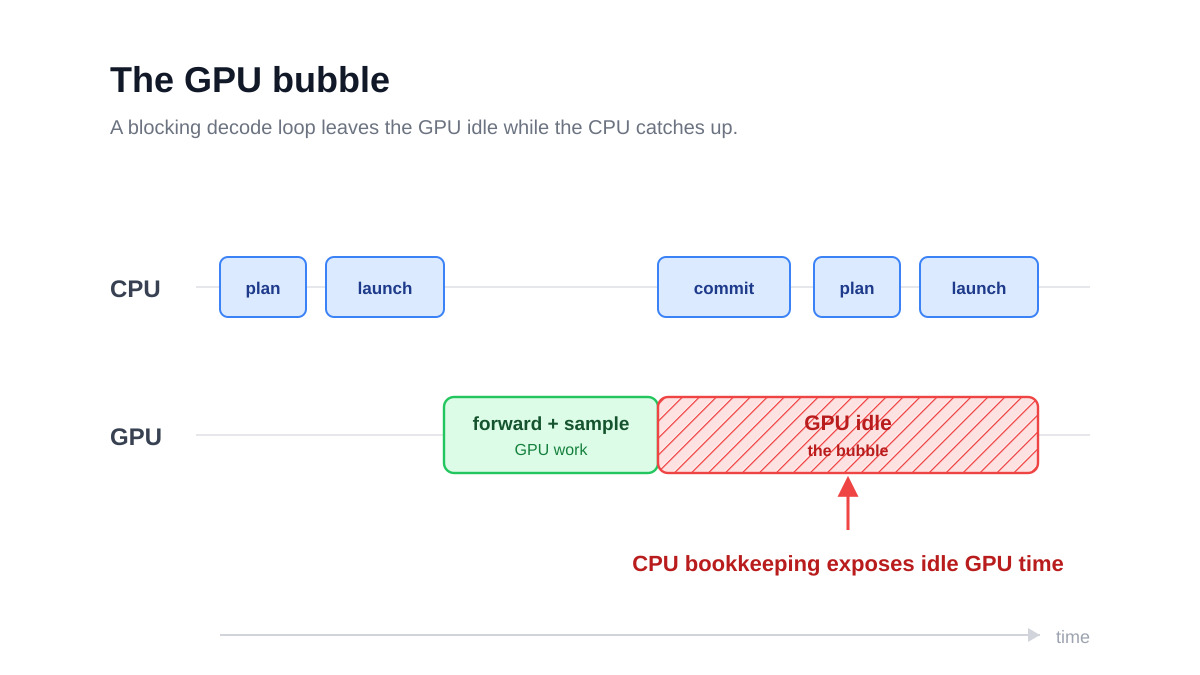
· 3 pulledThe GPU handles all the math involved in model inference, so at first glance it doesn't seem like there's much to it: just tell it what to do and wait for the answer.
But if you start looking at how it actually works under the hood, you find that the GPU often sits idle, not for lack of work, but because the CPU hasn't told it what to do next yet.
This phenomenon is called a GPU bubble.
You might also wanna read


AI-Driven Approach for Portable GPU Kernels in High-Performance Computing
This academic paper from North Carolina State University researchers presents an approach to leveraging AI ecosystems for creating portable
 hgpu.org·18d ago
General Compute Launches ASIC-Based Inference Cloud for Faster AI Agent Performance
General Compute is an inference cloud built on ASICs (purpose-built alternatives to Nvidia GPUs) designed specifically for AI inference, not
 Product Hunt·2mo ago
ZeroGPU launches edge-optimized small language models for cost-efficient AI inference
ZeroGPU is an AI infrastructure company that uses small language models running on a hybrid edge network to handle high-volume, repeatable A
Product Hunt·29d ago
Photonics emerges as a solution to AI's data transfer bottleneck as Nvidia invests billions
The article discusses how the AI boom, while unprecedented in capital investment and societal impact predictions, faces major bottlenecks in
 cnb.cx·1mo ago
SOLAR: An Automated Framework for Speed-of-Light Performance Analysis of Deep Learning Models
This paper introduces SOLAR, an automated framework for computing Speed-of-Light (SOL) analysis — the theoretical minimum execution time for
 arxiv.org·7d ago
SOLAR: An Automated Framework for Speed-of-Light Performance Analysis of Deep Learning Models
This paper introduces SOLAR, an automated framework for computing Speed-of-Light (SOL) analysis — the theoretical minimum execution time for
arxiv.org·7d ago
The Critical Role of GPU Kernel Quality in Machine Learning System Performance
This article discusses the critical role of GPU kernel quality in machine learning system performance. It highlights that end-to-end speed i
 mlc.ai·11d ago
Comments
Sign in to join the conversation.
No comments yet. Be the first.