
























Only 12% of TBCB Transmission Projects Met SCOD, Raising RE Curtailment Risks: ICRA
By
Chitrika Grover
2h agoen
Source
 Saur EnergyOnly 12% of TBCB Transmission Projects Met SCOD, Raising RE Curtailment Risks: ICRAsaurenergy.com
A latest report by ICRA has highlighted a mismatch between the rapid growth in renewable energy (RE) projects and the pace of associated transmission infrastructure development in the power sector. It anticipates that the transmission sector is set to witness a multi-year capex upcycle. The rating agency projects the sector to witness capital expenditure of Rs. 5-6 trillion between FY2026-27 and FY2031-32 . However, it cautioned that execution-related challenges, particularly those related to land acquisition and right of way (RoW), continue to persist. These issues could delay project completion timelines. Such delays, in turn, could lead to grid curtailment for renewable energy developers, thereby affecting their project returns. Commenting on the findings, Ankit Jain, Vice President and Co-Group Head, ICRA Limited , said that the projected Rs. 5-6 trillion transmission capex includes strengthening existing infrastructure, adding evacuation capacity, and developing new transmission routes to support generation centres. He further said that the upcoming investment will be driven by the Government's plan to evacuate power from over 900 GW of non-fossil fuel capacity by 2035-36 , of which around 548 GW will comprise solar and wind capacity . Commenting on these execution challenges, Jain said, "Most transmission projects awarded by the central nodal agencies through the tariff-based competitive bidding (TBCB) route have been delayed beyond their Scheduled Commissioning Date ( SCOD ) due to these challenges. Out of the total projects commissioned by March 2026 under this route, only around 12% were completed within the scheduled timeline, while the remaining projects were commissioned with delays ranging from two months to three years, with a median delay of over 10 months. This delay in transmission capacity addition increases the risk of inadequate power evacuation for renewable energy developers, resulting in grid curtailment." Grid Curtailment of 33% Persists as of May 2026 ICRA's research also noted that around 33% of recently commissioned renewable energy capacity was being evacuated under the Temporary General Network Access ( T-GNA ) route as of May 2026 , reflecting persistent transmission constraints as infrastructure additions continue to lag renewable capacity growth. These transmission expansion efforts are expected to support the Government's plan to evacuate power from over 900 GW of non-fossil fuel capacity by 2035-36 . Outstanding orders and order inflows for key transmission equipment suppliers during FY2025-26 have more than doubled compared to FY2021-22 . ICRA expects the anticipated surge in transmission capex over the coming years to drive healthy order inflows for these companies. However, supply-side constraints arising from the limited manufacturing capacity of equipment suppliers and shortages of skilled manpower continue to constrain execution timelines. Unless these capacities are expanded, delays in transmission infrastructure additions may persist. Moreover, such a significant increase in transmission capacity requires execution-related bottlenecks to be addressed. Addressing the transmission gap, Jain added, "ICRA estimates that to reach close to the target set by the Government in its earlier National Electricity Plan-II, the sector requires a significant increase in annual transmission line and substation capacity additions of about 20,000 circuit kilometres (ckm) and 120 gigavolt-amperes (GVA), respectively. This entails an investment opportunity of at least Rs. 5-6 trillion between 2026-27 and 2031-32." Transmission Constraints or Inadequate T-GNA Margins Can Lead to RE Curtailment in the ISTS Network The report noted that since the last fiscal year, generators have faced significant renewable energy curtailment in regions with high RE penetration, where transmission evacuation infrastructure is yet to become fully operational. It stated that renewable energy curtailment in the Interstate Transmission System (ISTS) network is largely driven by transmission constraints or inadequate Temporary General Network Access (T-GNA) margins, resulting in the non-scheduling of power. He further added, "Out of the recently commissioned total RE capacity of 54.8 GW, around 33% is being evacuated under the T-GNA route at the all-India level as of May 2026. Further, curtailment under T-GNA is highest during solar hours and has remained in the range of 50-60% during the same period. These instances are more prominent in Rajasthan and Gujarat, while curtailments in the southern region remain limited even during solar hours." Sharing the outlook, Jain said, "A large pipeline of projects of around 107 GW across solar, wind, hybrid, hydro, pumped storage and thermal segments, which have already been granted connectivity, is planned to be integrated into the ISTS network between 2026-27 and 2030-31. As seen in the past, slippages in the timely commissioning of the upcoming transmission infrastructure cannot be ruled out, which could impact renewable energy capacity additions or result in continued grid curtailment for RE developers, materially affecting the return metrics of these projects."
You might also wanna read
Petition of Electricity Act for Adoption of Transmission Charges of the “Transmission system for evacuation of power from RE Projects in Morena SEZ in Madhya Pradesh- Phase I” – EQ
Solar Quarter·1d ago


Report warns 90% of India's renewable energy sites face high climate risk by 2030
A report by Zurich Kotak General Insurance and Zurich Resilience Solutions warns that approximately 90% of India's renewable energy portfoli
 thehindubusinessline.com·12d ago
Report: 90% of India's Planned Renewable Energy Projects Face High Climate Risks by 2030
A report by Zurich Kotak General Insurance and Zurich Resilience Solutions warns that nearly 90% of India's planned renewable energy portfol
 businessworld.in·10d ago
Transmission Network Constraints Drive Rising Wind Curtailment Costs in Great Britain
This analysis examines the growing issue of wind farm curtailment in Great Britain's electricity system, focusing on how transmission networ
 ukerc.ac.uk·9mo ago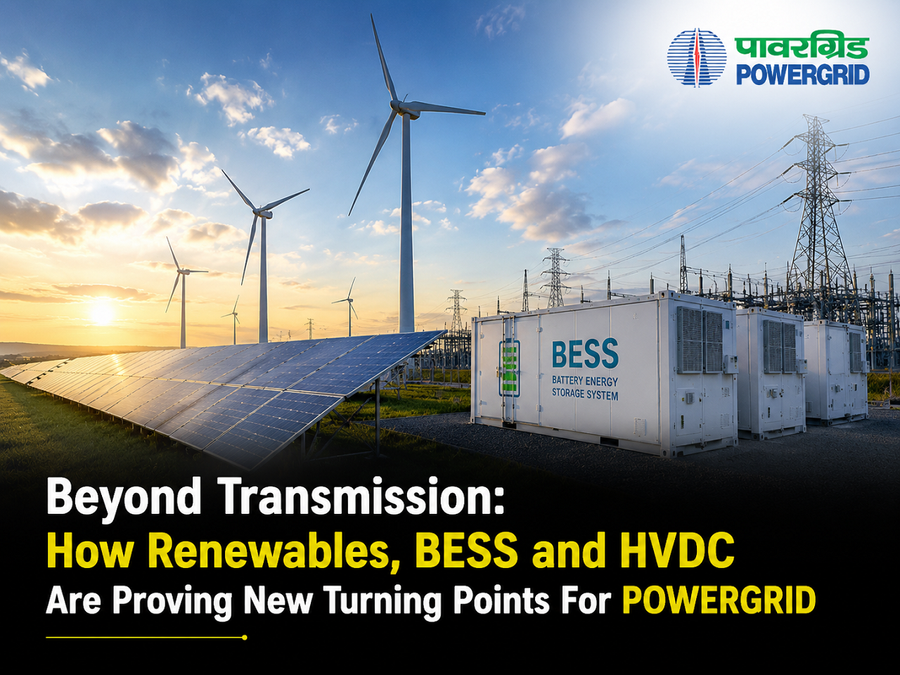
POWERGRID shifts strategy to renewable evacuation, battery storage, and HVDC for next growth phase
Power Grid Corporation of India (POWERGRID) is pivoting its growth strategy beyond traditional transmission to focus on renewable energy eva
/saur-energy/media/agency_attachments/2025/06/20/2025-06-20t080313673z-favicon-prasanna-singh-1-2025-06-20-13-33-13.png) saurenergy.com·5d ago
saurenergy.com·5d ago2025 Iberia Blackout Report
media.licdn.com·1y ago
Comments
Sign in to join the conversation.
No comments yet. Be the first.