
























Neural Audio Codecs: Bridging the Gap Between Language Models and Audio Processing
Why modeling audio is harder than text, and how to make it feasible with neural audio codecs.
Read the full articleYou might also wanna read


Speech Enhancement: A New AI Approach
A novel framework uses language models to enhance audio-visual speech quality. By integrating sentiment analysis, the method surpasses tradi
Developer Cuts Voice Agent Latency 5x by Streaming Sentences and Trimming Model Overhead
A developer building a local voice assistant found that fast LLM responses alone do not guarantee a smooth user experience, as delays accumu
Improving quality and robustness in LLM-based text-to-speech systems
Low-rank adaptation, data augmentation, and chain-of-thought reasoning are among the techniques enabling accent-free polyglot outputs, impro

Transformer LMs encode some relational knowledge linearly, but not all
Much of the knowledge encoded in transformer language models (LMs) may be expressed in terms of relations: relations between words and their
 arxiv.org·9d ago
Why Your Audio Model Can't Say 'No'
Negation is the Achilles' heel for audio-language models. Current designs fail to tell what's there from what's not, pointing to a fundament
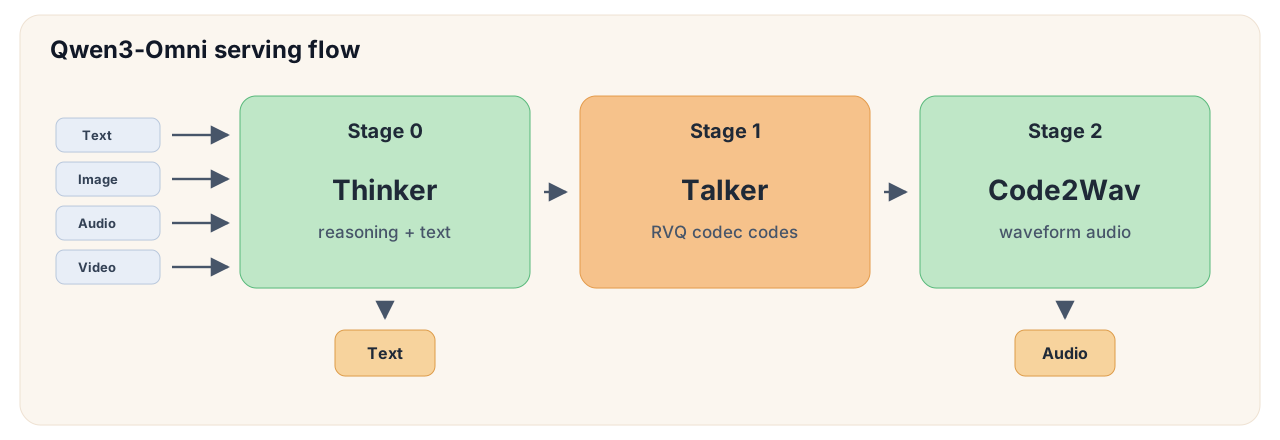
vLLM-Omni: Serving Qwen3-Omni with a Multi-Stage Pipeline for Multimodal Speech Generation
How vLLM-Omni serves and optimizes Qwen3-Omni with staged Thinker-Talker-Code2Wav execution, batching, CUDA Graphs, async chunk, async outpu
 vllm.ai·14d ago
Comments
Sign in to join the conversation.
No comments yet. Be the first.