

























Exploring union types in .NET 11 (C# 15): A developer's guide to the new feature
By
Andrew Lock
Summary
This article explores the introduction of union types in .NET 11 (C# 15), a long-requested feature. The author explains what union types are, how to use them, their implementation details, and how developers can create custom union types. It's part of a series on .NET 11 preview features, written from the perspective of an ASP.NET Core developer sharing hands-on experiences.
Source
 bskyExploring union types in .NET 11 (C# 15): A developer's guide to the new featureandrewlock.net
Key quotes
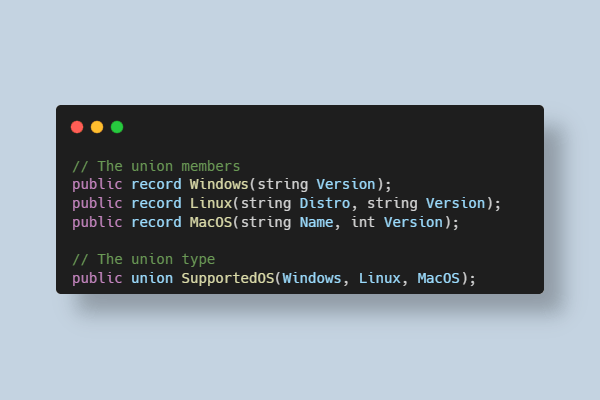
· 3 pulledUnions are one of those features that have been requested for years, and in .NET 11 (or rather, C# 15) they're finally here.
In this post I describe what that support looks like, how you can use them, how they're implemented, and how you can implement your own custom types.
This blog is where I share my experiences as I journey into ASP.NET Core.
You might also wanna read


Approaches to Representing Heterogeneous Data in Programming Language Design
The article discusses the challenge of representing heterogeneous data in programming languages, specifically in the context of developing a

Implementing Type-Safe Generic Data Structures in C Using Unions and Typeof
The article discusses a unique technique for implementing type-safe generic data structures in C using unions and typeof. It focuses on crea
danielchasehooper.com·11mo ago
Unconventional Type Casting Techniques in TypeScript
This article explores unconventional methods for type casting in TypeScript, moving beyond the standard 'as' operator. It presents various c
 wolfgirl.dev·8mo ago
Exploring Extensible Data Types in Rust with CGP: Modular Interpreters and Extensible Visitors
The article discusses Programming Extensible Data Types in Rust with CGP, focusing on modular interpreters and extensible visitors. It cover
contextgeneric.dev·11mo agoNew Rule for Struct Compatibility in C23 Enables Type Parameterization
C23 introduces a new rule for struct, union, and enum compatibility in C, allowing the same struct defined in different translation units to

Centralizing Error Handling in Rust with Custom AppError Enums
This article discusses the importance of centralizing error handling in Rust applications using a custom AppError enum combined with map_err
Comments
Sign in to join the conversation.
No comments yet. Be the first.