
























DecompR: A Method for Reducing Weighting Noise in Multi-Stakeholder LLM Alignment
Multi-stakeholder tasks require one output to satisfy users with conflicting preferences. Holistic LLM judges conflate utility estimation and utility aggregation, yielding unstable implicit weights…
Read the full articleYou might also wanna read


The Problem with Structured Outputs in LLMs: How Constrained Decoding Creates False Confidence
Constrained decoding seems like the greatest thing since sliced bread, but it often forces models to prioritize output conformance over outp
 boundaryml.com·6mo ago
Fair Document Valuation in LLM Summaries via Shapley Values
arXiv:2505.23842v5 Announce Type: replace Abstract: Large Language Models (LLMs) increasingly power search engines and AI assistants that re
Seeing the End at Step Zero: Accelerating Diffusion MLLMs via MLP Sparsity-Aware Truncation
arXiv:2607.14557v1 Announce Type: new Abstract: Diffusion Multimodal Large Language Models (DMLLMs) are highly effective for multimodal reas
Validating LLMs in social science: Epistemic threats and emerging norms
arXiv:2607.07915v1 Announce Type: cross Abstract: Large language models (LLMs) are reshaping social science methodology. Researchers increas

Compressing Prompts: A New Approach to LLM Efficiency
A novel method suggests compressing task-relevant information into a single activation vector. This could lead to more efficient large langu
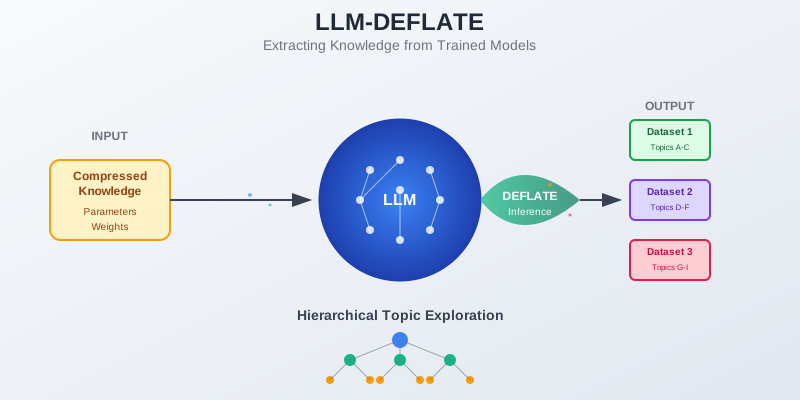
LLM-Deflate: Reversing Model Training to Extract Structured Datasets from Large Language Models
Large Language Models compress massive amounts of training data into their parameters. This compression is lossy but highly effective—billio
 scalarlm.com·10mo ago
Comments
Sign in to join the conversation.
No comments yet. Be the first.