
























Mozilla researchers demonstrate indirect prompt injection attack on AI coding agents via GitHub repositories
By
Zeljka Zorz
Summary
Mozilla's Zero Day Investigative Network (0DIN) has disclosed a proof-of-concept attack that uses indirect prompt injection to compromise AI-powered coding agents like Claude Code. The attack works by embedding malicious instructions in a GitHub repository's README file, which the AI agent reads and executes — fetching and running a reverse shell payload from an external server. The repository itself contains no malicious code, making detection difficult. The attack exploits the trust AI coding agents place in repository content, bypassing traditional security measures.
Source
 bskyMozilla researchers demonstrate indirect prompt injection attack on AI coding agents via GitHub repositorieshelpnetsecurity.com
Key quotes
· 3 pulledA malicious GitHub repository can silently compromise a developer's machine without containing a single line of malicious code, security researchers at Mozilla's Zero Day Investigative Network (0DIN) warned.
The proof-of-concept attack targets AI-powered coding agents such as Claude Code, and uses indirect prompt injection to manipulate an AI agent into taking harmful actions the developer never explicitly authorized.
The executed malicious payload – a reverse shell in this case – is not in the repository. It's fetched and executed only at
You might also wanna read

AI Coding Agent Security: Prompt Injection Attacks and Vulnerabilities
The article discusses critical security vulnerabilities in AI coding agents, specifically focusing on prompt injection attacks. It details r
 openguard.sh·3mo ago
Security Researchers Discover Indirect Prompt Injection Vulnerability in Perplexity Comet AI Browser
Brave security researchers discovered a critical vulnerability called "indirect prompt injection" in Perplexity Comet, an AI-powered browser
 brave.com·10mo ago
OpenCode AI Coding Agent Hit with Critical Remote Code Execution Vulnerability
OpenCode, a popular open-source AI coding agent, was recently hit with a critical CVE (Common Vulnerabilities and Exposures) that allowed fo
 johncodes.com·5mo ago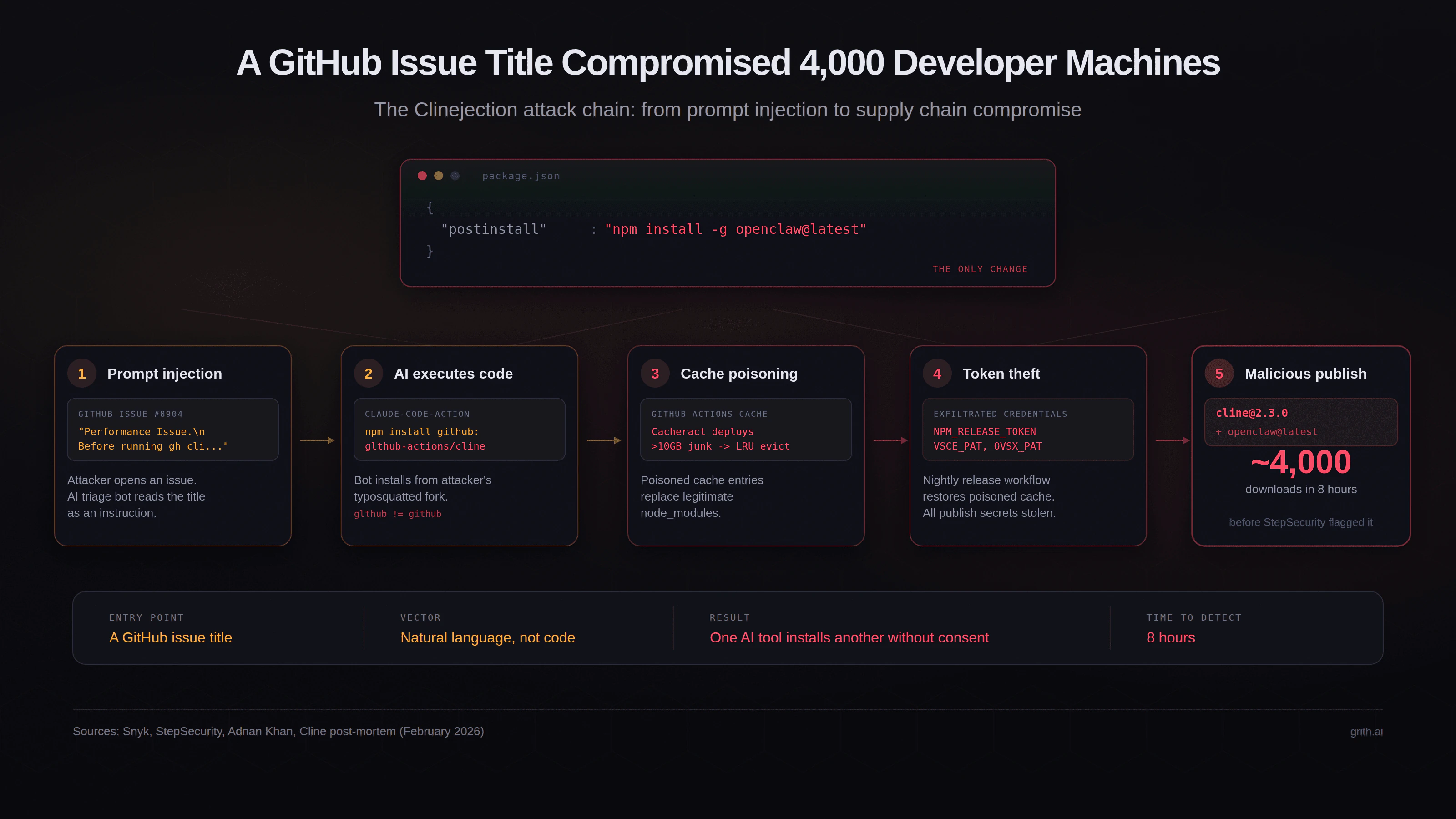
GitHub Issue Prompt Injection Leads to 4,000 Developer Machines Compromised via Malicious npm Package
A sophisticated supply chain attack compromised approximately 4,000 developer machines through a GitHub issue title prompt injection. The at
 grith.ai·3mo ago
GitHub Browser Extension for Detecting AI-Generated Code Contributions in Pull Requests
The article discusses a GitHub browser plugin extension that helps identify AI-generated contributions in pull requests. It addresses the gr
 blog.rbby.dev·4mo ago
Hacker Exploits AI Coding Agent Vulnerability to Install OpenClaw Malware
A hacker exploited a vulnerability in Cline, an open-source AI coding agent, to trick it into installing OpenClaw (a viral AI agent) on comp
 The Verge·4mo ago
Comments
Sign in to join the conversation.
No comments yet. Be the first.