
























Understanding the Linux Filesystem Hierarchy: A Guide for Sysadmins and Cybersecurity Professionals
By
HackMoN Ai
Summary
This article provides an in-depth exploration of the Linux Filesystem Hierarchy Standard (FHS), explaining the purpose and structure of key directories from root (/) through /bin, /etc, /var, /tmp, /proc, /sys, /dev, /usr, /home, and /root. It emphasizes the cybersecurity and system administration importance of understanding this hierarchy for threat detection, forensic analysis, privilege escalation defense, and system hardening. The piece covers each major directory's role, security implications, and practical commands for monitoring and securing the filesystem.
Source
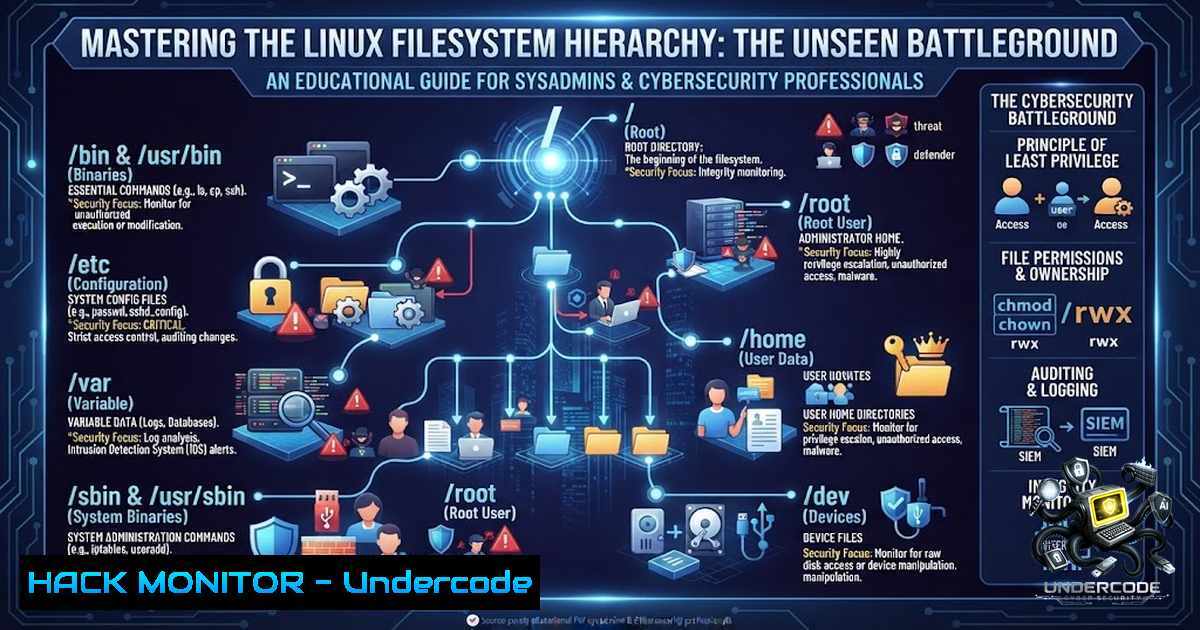
 bskyUnderstanding the Linux Filesystem Hierarchy: A Guide for Sysadmins and Cybersecurity Professionalsundercodetesting.com
Key quotes
· 5 pulledFor a Windows user, everything lives under C:\, but for a Linux professional, the hierarchy begins at the root (/), a unified tree that dictates how devices, processes, and configurations interact.
For cybersecurity analysts, understanding this hierarchy is akin to a detective knowing the layout of a crime scene—it is essential for identifying anomalies, hardening systems, and conducting forensic investigations.
The /proc filesystem is a pseudo-filesystem that provides a window into the kernel's view of running processes. It is one of the most powerful tools for both system monitoring and forensic analysis.
The /tmp directory is a common vector for privilege escalation attacks. Understanding its permissions and behavior is critical for securing a Linux system.
Mastering the filesystem hierarchy is not just about knowing where files live; it is about understanding the logic behind the structure and using that knowledge to secure, monitor, and troubleshoot Linux systems effectively.
You might also wanna read


Modernizing the Filesystem Hierarchy Standard for Linux
The article discusses the outdated Filesystem Hierarchy Standard (FHS) for Linux systems, which has remained unchanged since 2015. It highli
 lwn.net·10mo ago
Understanding Linux Capabilities: Fine-Grained Access Control for System Security
This technical article explores Linux capabilities, which provide fine-grained access control by dividing root privileges into distinct unit
 dfir.ch·8mo ago
Exploring Language Models' Capabilities in Filesystem Design and Implementation
The article explores the intersection of language models and filesystem design, examining how coding models can generate functional filesyst

Technical Analysis of the Unix Shebang/Hash-Bang Mechanism (#!) Across Various Unix Flavors
This technical article provides a comprehensive examination of the Unix shebang/hash-bang mechanism (#!), covering its historical origins, i
in-ulm.de·7mo ago
FZF-Powered Shell Aliases and Functions for Simplified Systemctl Commands
This article presents a collection of shell aliases and functions that use fzf (fuzzy finder) to simplify systemctl commands for managing sy
 silverrainz.me·9mo ago
Enhancing Confidential Computing: Rethinking Linux Cloud Infrastructure for Secure Virtual Machines
This article discusses the limitations of privacy in public cloud computing and explores technical approaches to enhance confidentiality for
lwn.net·10mo ago
Comments
Sign in to join the conversation.
No comments yet. Be the first.