
























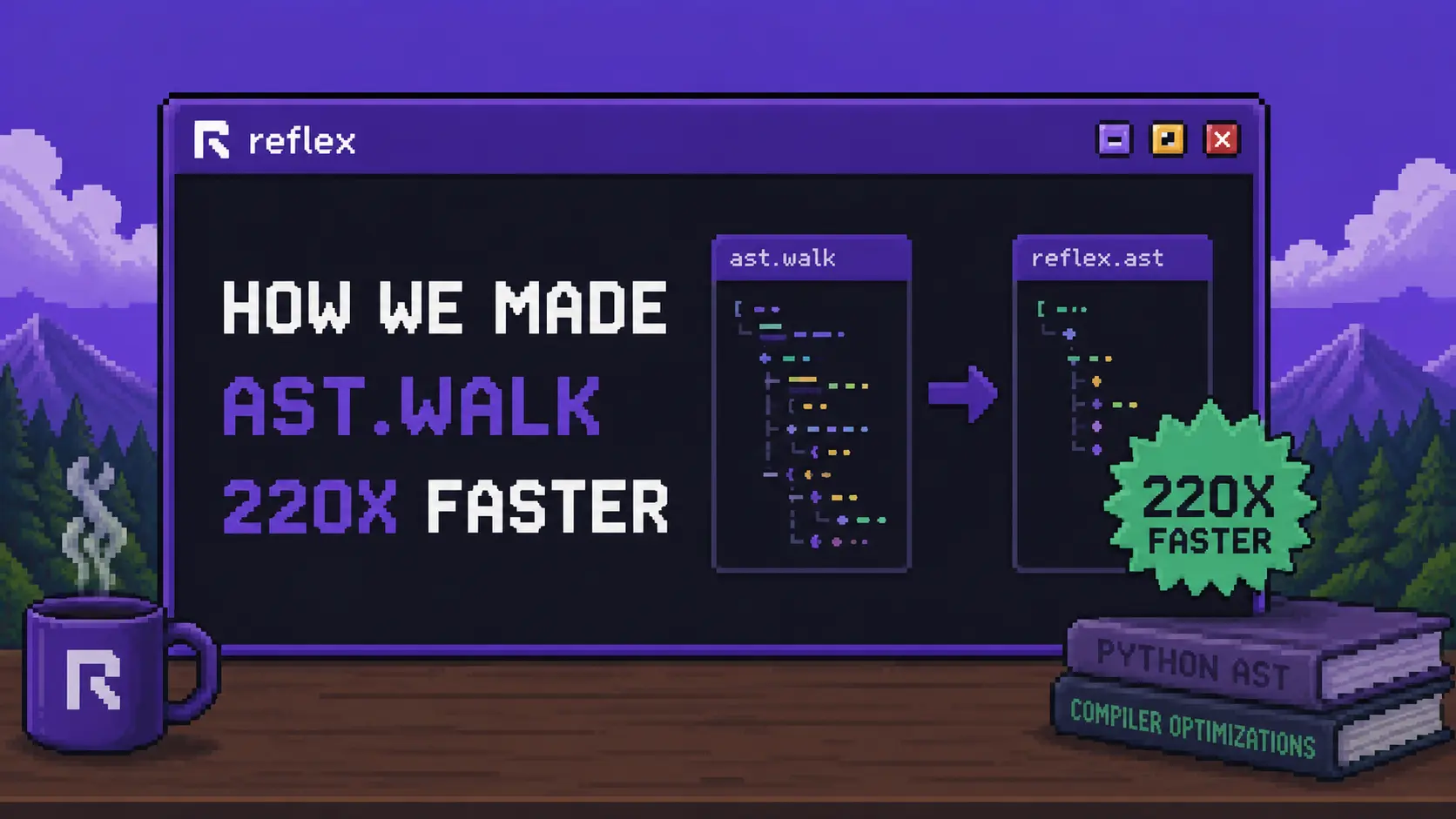
Optimizing Python's ast.walk: Achieving 220x Performance Improvement
By
Khaleel Al-Adhami
Summary
The article discusses how the author's team optimized Python's ast.walk function to achieve a 220x speed improvement. They generate massive amounts of Python code for an AI reflex-app builder, and use linting to catch multiple code generation errors at once rather than one at a time. The optimization involves replacing ast.walk with a faster custom implementation called ast.sprint, dramatically improving performance for their code generation pipeline.
Source
 Hacker NewsOptimizing Python's ast.walk: Achieving 220x Performance Improvementreflex.dev
Key quotes
· 3 pulledRunning reflex compile will eventually find all of those bugs, but it only finds one issue at a time.
That means if the AI made multiple mistakes, we are increasing the latency massively for what could be relatively simple fixes.
As such, we decided using a linter would be the best approach to fix th
You might also wanna read


Python 3.14 Delivers JIT Compiler and GIL-Free Concurrency
Python 3.14 introduces two major features: a new JIT (Just-In-Time) compiler and the removal of the Global Interpreter Lock (GIL), enabling
 towardsdatascience.com·15d ago
Improving code quality with linting in Python

Python 3.15 Preview: Upgraded JIT Compiler Brings Performance Improvements
Python 3.15 introduces significant improvements to its experimental Just-In-Time (JIT) compiler, including a new tracing frontend, basic reg
 realpython.com·3d ago
Bun v1.3.10

Bun v1.0.15

The real value of AI coding models isn't speed — it's lowering the barrier to doing things you'd otherwise skip
The article argues that the true value of AI coding models isn't their speed at generating code, but their ability to make previously expens
 ayende.com·3d ago
Comments
Sign in to join the conversation.
No comments yet. Be the first.