
























Amazon rainforest canopy chemistry study reveals how biomass burning and biogenic emissions influence ozone dynamics
Summary
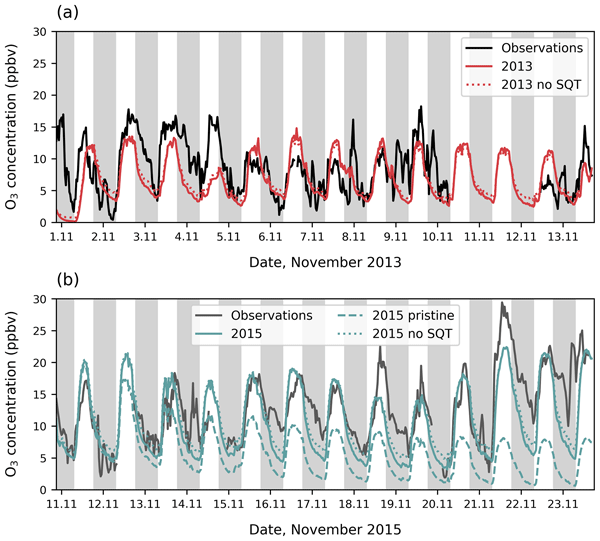
This scientific study applies the FORCAsT v2 canopy column model to an Amazonian rainforest site to investigate how in-canopy chemistry affects above-canopy concentrations of ozone (O3) and bi-directional exchange of natural compounds. The research, focused on the 2015 El Niño period, finds that biomass burning enhances O3 flux into the canopy, increasing oxidation chemistry and O3 deposition to vegetation. Key findings include: sesquiterpenes enhance O3 chemical loss from ~3% to 10-15% of total in-canopy losses; sesquiterpene canopy escape efficiency varies by 45-55% controlled by O3 oxidation and vertical turbulence; soil NOx escape efficiency (40-50%) is higher than many models suggest with a strong diurnal cycle driving O3 production; and pool-dependent emissions for BVOCs show variability in escape efficiency. The study highlights reactive BVOCs (especially sesquiterpenes) as major sources of uncertainty and emphasizes turbulence's critical role in linking canopy processes to above-canopy atmospheric composition.
Source
 bskyAmazon rainforest canopy chemistry study reveals how biomass burning and biogenic emissions influence ozone dynamicsacp.copernicus.org
Key quotes
· 5 pulledSensitivity tests show sesquiterpenes enhance O3 chemical loss from approximately 3 % of the total in-canopy losses to 10 %–15 %, but only marginally reduce the total canopy O3 flux.
Average soil NOx escape efficiency (40 %–50 %) is higher than many existing models suggest and exhibits a strong diurnal cycle that drives O3 production, especially in the early morning, which may be important to consider in global atmospheric chemistry models.
We highlight reactive BVOCs by inclusion of sesquiterpene emissions and reactivity as major sources of uncertainty in in-canopy chemistry and emphasise the critical role of turbulence in linking canopy processes to above-canopy atmospheric composition.
Simulation of the 2015 El Niño shows that biomass burning enhances O3 flux into the canopy, increases oxidation chemistry and elevates O3 deposition to vegetation.
Sesquiterpene canopy escape efficiency varies by 45 %–55 % across simulations, controlled by O3 oxidation and vertical turbulence.
You might also wanna read


Moderate volcanic eruptions and extreme wildfires humidify the stratosphere

A benchmark for how different disturbances influence the loss and recovery of carbon and CO₂ in tropical forests
NASA's ocean-studying PACE satellite captures wildfire smoke plumes over Canada from space
A NASA satellite originally designed to study Earth's oceans (PACE - Plankton, Aerosol, Cloud, ocean Ecosystem) has proven unexpectedly usef
 Space·3d ago
NASA's ocean-studying PACE satellite captures wildfire smoke plumes over Canada from space
A NASA satellite originally designed to study Earth's oceans (PACE - Plankton, Aerosol, Cloud, ocean Ecosystem) has proven unexpectedly usef
space.com·3d ago
WMO Bulletin Vol. 75(1): The Air Issue
 wmo.int·4d ago
Study finds giant tropical trees compensate for height-related water transport challenges
New research led by the University of Exeter and Cardiff University, published in the journal Science, challenges conventional scientific th
 news.exeter.ac.uk·1d ago
Comments
Sign in to join the conversation.
No comments yet. Be the first.