





















Lead-Free Organic-Inorganic Halobismuthate Material Developed for Large Piezoelectric Effect
By
PaulHoule

Hand-rolled, kettle-boiled, baked to perfection. Worth every minute at the bakery.
Summary
Researchers have developed a lead-free organic-inorganic halobismuthate material with significant piezoelectric properties, offering a promising alternative to toxic lead-based piezoelectrics like PZT. The study focuses on tailoring the molecular structure to achieve a large piezoelectric effect through careful design of the organic cation and inorganic framework. This breakthrough in molecular piezoelectrics could enable new applications in flexible electronics, sensors, and energy harvesting devices while addressing environmental and health concerns associated with traditional lead-containing materials.
Key quotes
· 4 pulledOwing to their lack of inversion symmetry, piezoelectric materials can generate electrical polarization in response to mechanical stress, and vice versa.
Among these, ferroelectrics tend to be the best performing as they exhibit spontaneous polarization, which can be switched by an external electric field to produce a stronger piezoelectric response.
Molecular piezoelectrics are a potentially disruptive technology, enabling a new generation of self-powered electronics that are flexible, high performing, and inherently low in toxicity.
High-performance ferroelectrics such as lead zirconium titanate (PZT) ceramics (dij ∼ 200) have dominated applications but contain toxic lead.
You might also wanna read


Parker Solar Probe flies through Sun's corona at 430,000 mph with revolutionary heat shield technology
NASA's Parker Solar Probe is successfully flying through the Sun's outer atmosphere (corona) at 430,000 mph, protected by a 4.5-inch carbon
 spacedaily.com·23h ago
Scientists stabilize elusive crystal phase using silver nanoparticles, unlocking room-temperature quantum properties
Researchers from Brown University and the University of Michigan have created and stabilized a previously theoretical state of matter by arr
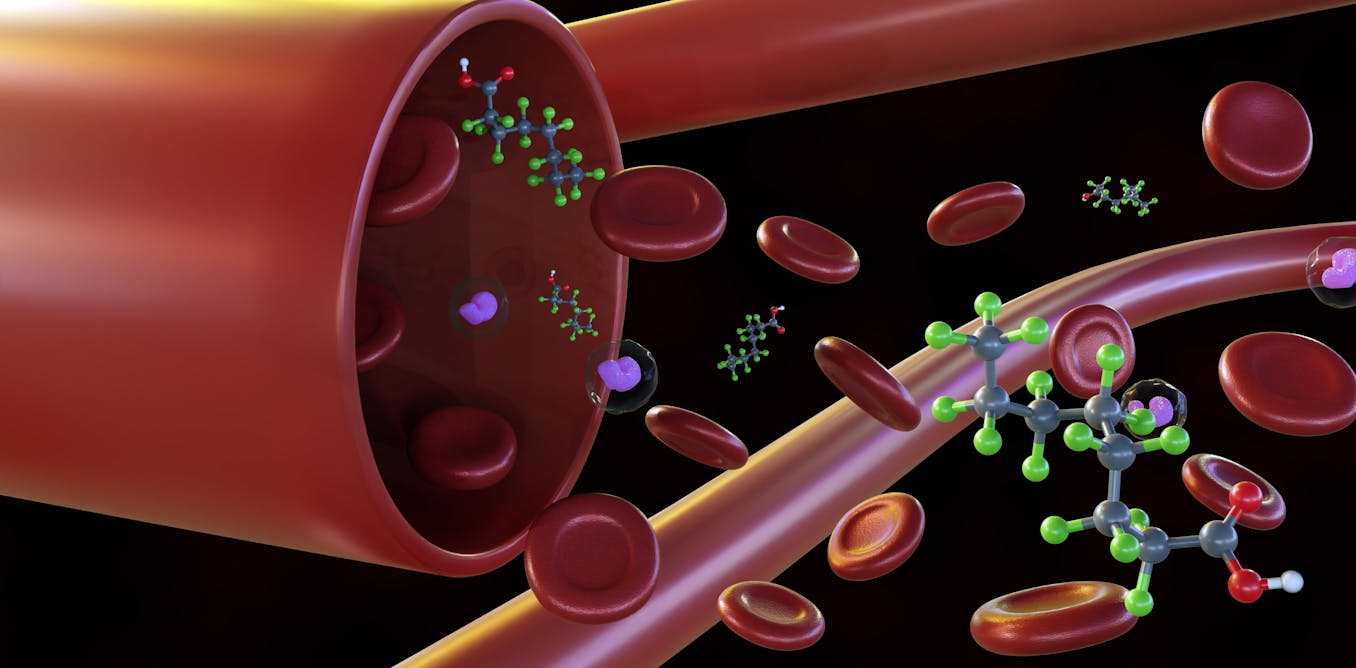
How PFAS leave detectable fingerprints in human blood as researchers trace their health impacts
PFAS (per- and polyfluoroalkyl substances) are synthetic chemicals found in virtually all living organisms, including humans. Researchers ar
 theconversation.com·23h ago
University of Illinois researchers develop 3D chip stacking technique to extend Moore's Law
Researchers at the University of Illinois Grainger College of Engineering have developed a breakthrough in 3D chip manufacturing that could

Kyushu University achieves 130% quantum yield in solar cells using molybdenum spin-flip emitter and singlet fission
Researchers at Kyushu University, in collaboration with German scientists, have achieved a 130% quantum yield in solar energy conversion usi
 energiesmedia.com·1d ago
Gallium phosphide-titanium solar cell shows potential for 60% energy conversion efficiency
Researchers have developed a solar cell using gallium phosphide (GaP) and titanium (Ti) that could theoretically achieve 60% energy conversi
 interestingengineering.com·1d ago